
How do you read mold test results?
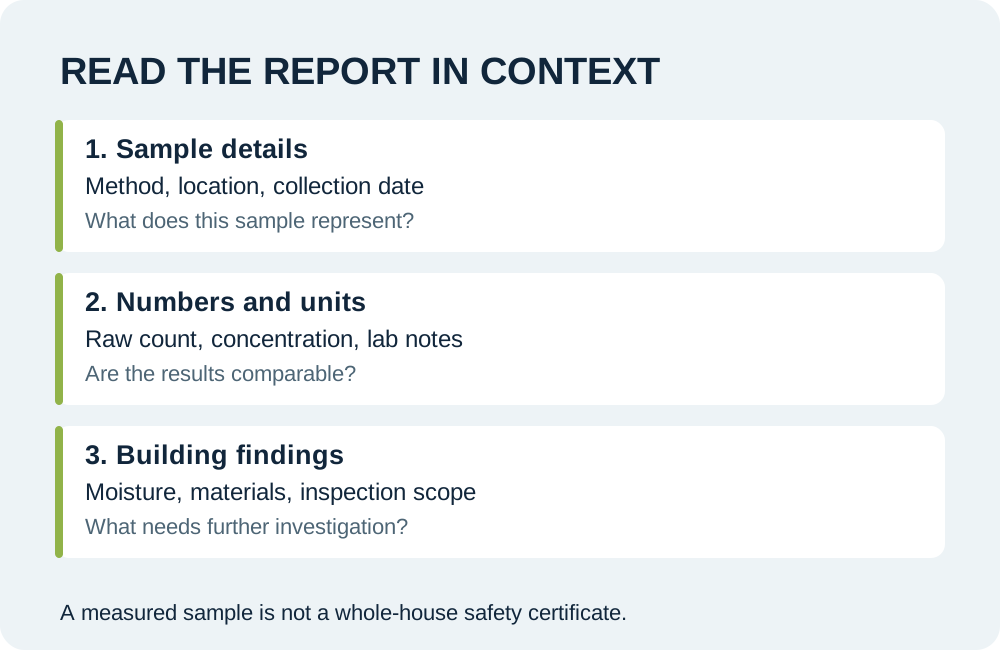
Read the sample method and location first, then the units, reported spore groups and laboratory comments. Compare compatible results with the inspection findings before deciding what they mean. A lab table describes submitted samples; it is not a whole-house safety certificate.

- Match the sample ID to the room or surface. Check the collection date, not just the date the lab issued the report.
- Identify what was measured. Air, surface and dust samples answer different questions.
- Read the unit beside the number. A raw count is different from spores per cubic meter.
- Check qualifications. Detection limits, debris and an overloaded sample can affect interpretation.
- Connect the result to the building. Include water damage, moisture readings, odors and visible growth.
The U.S. Environmental Protection Agency (EPA) states that no federal airborne mold limits have been established. A report cannot demonstrate compliance with an EPA mold-spore standard that does not exist. For the inspection and sampling process, see air quality testing.
What do the columns in a mold report mean?
Sample identifiers tell you where the evidence came from; counts and units describe what the laboratory measured. Read the legend because laboratories use different headings and symbols. The EMLab P&K sample report illustrates separate columns for counts, concentration, detection limits and percentages.
| Field | Meaning | Interpretation limit |
|---|---|---|
| Sample ID and location | The collected sample's identifier and recorded sampling point. | One bedroom sample does not describe every bedroom or a concealed wall. |
| Sample volume, liters | The amount of air drawn through the collector. | This is sampled air, not the room's total volume. |
| Raw count | Particles counted in the laboratory's examined portion. | Do not compare raw counts from different volumes or counting procedures. |
| Spores/m³ or count/m³ | Estimated concentration per cubic meter of sampled air. | It is not the number of spores in the entire house. |
| Percent of total | A group's share of the reported total. | A percentage is not a separate exposure level or severity rating. |
| Detection limit or sensitivity | The method's reported ability to detect or quantify a result. | A non-detect is not proof that the building contains zero spores. |
| Background debris and comments | Notes on visibility, sample quality and qualifications. | A small number may need caution if the sample was difficult to analyze. |
How are raw counts converted to spores per cubic meter?
A concentration scales the observed count to the volume sampled, with any adjustment required by the laboratory's counting method. One cubic meter contains 1,000 liters. The following fictional arithmetic example assumes the whole deposited trace was counted, so no subsampling adjustment is needed.
| Item | Example value | Calculation or meaning |
|---|---|---|
| Air volume | 75 liters | 75 ÷ 1,000 = 0.075 m³ |
| Spores counted in the whole trace | 12 | The count used in this simplified example. |
| Calculated concentration | 160 spores/m³ | 12 ÷ 0.075 = 160 |
| One counted spore | About 13.3 spores/m³ | 1 ÷ 0.075; not a health threshold. |
If only part of the trace was examined, this shortcut is incomplete. Use the reported laboratory result and its method notes rather than replacing it with a home calculation. Rounding can also prevent a displayed total from matching the sum of rounded rows exactly.
The numbers here teach unit conversion only. They do not define a normal result, an allowable concentration or a remediation trigger.
Should indoor mold levels be lower than outdoor levels?
Indoor and outdoor samples provide useful context, but a lower indoor total does not automatically mean there is no indoor source. Compare the reported groups as well as totals, and check that the collection and analysis are comparable. A missing outdoor sample limits that particular comparison; it does not erase a visible leak or growth found during inspection.
An EMLab P&K technical explanation shows why different spore populations can be hidden by a total-only comparison. Even a shared grouping can contain organisms that the routine method does not distinguish.
| Evidence | Situation A | Situation B |
|---|---|---|
| Indoor total | 600 spores/m³ | 600 spores/m³ |
| Outdoor comparison | 900 spores/m³, with a broadly similar reported distribution. | 900 spores/m³, but a different distribution of reported groups. |
| Building findings | No dampness found in the inspected locations. | A wet wall and persistent odor in the sampled room. |
| What changes | Interpret the sample within the documented inspection's limits. | Investigate the wet wall and assess affected materials despite the lower indoor total. |
Neither situation establishes health safety. These are teaching scenarios, not customer cases. The useful difference is the evidence available for a building decision, not a pass/fail ratio.
What does Aspergillus/Penicillium-like mean on a report?
It usually identifies a microscopic appearance group rather than confirming one species. Routine spore-trap analysis may not distinguish the similar spores within that grouping. Read the laboratory's glossary and any suffixes such as “types,” “like” or “++.”
A genus name, a grouped category and a species identification are different levels of detail. Do not turn a grouped row into a diagnosis or a claim that a specific toxin was measured. Our guide to types of mold in homes explains why names and appearance have limits.
Does “not detected” mean there is no mold?
No. “Not detected” describes the submitted sample under that method's conditions, not every surface and cavity in the building. Check the reporting limit and laboratory notes before treating a dash, zero or ND as interchangeable.
EMSL's sample report explains that heavy background particles can obscure spores and cause underestimation. Its overloaded-sample category prevents accurate quantification. These are laboratory-specific annotations, so use your own report's legend rather than transferring a rating from another lab.
Keep collection time separate from report age. A sample collected before a later leak cannot describe the new damage, even if the PDF arrived today.
Can you compare air, surface, culture and ERMI results?
Not as if they were the same measurement. Compare compatible methods and units. A sample from one surface answers a narrower location question than an air sample, and a dust index is not an airborne spore concentration.
- Spore-trap air analysis: typically reports observed categories and concentrations in air.
- Culture analysis: reports growth under the culture conditions, often in colony-forming units (CFU). CFU is not interchangeable with a microscopic spore count.
- Tape, swab or bulk sample: represents the submitted surface or material. Check whether the result is qualitative, a count or a proportion.
- ERMI dust result: uses DNA-based analysis and an index. The EPA describes ERMI as a research tool and does not recommend its use outside research.
A growing colony on a home test plate does not supply the missing volume needed to calculate a room's spores/m³. Do not apply an air-report scale to a plate or surface result.
What mold count is dangerous or requires remediation?
There is no universal health-based indoor mold count that divides safe from dangerous conditions. The National Institute for Occupational Safety and Health (NIOSH) states that short-term spore counts and culture results cannot be interpreted as health-risk measurements. A lab's flag or score needs its stated purpose and limitations.
NIOSH also cautions that short samples, particularly negative findings, may not represent actual exposure. A building report cannot diagnose the cause of someone's symptoms. Discuss health concerns with a clinician and use the property assessment to address dampness and damaged materials.
Visible growth generally does not require sampling before action, according to the EPA. An unexplained elevation can justify a targeted mold inspection; it does not by itself establish the location or size of material that needs removal.
Can a passing air test prove remediation is complete?
A sample result alone cannot establish that every part of the cleanup is complete. Review it alongside the work area, remaining materials, moisture correction and any project-specific verification criteria. Ask what a “pass” means in that report rather than assuming it is a federal safety certification.
Our post-remediation verification page explains the completion review. If the report points to an unresolved property problem, the next step is a defined investigation and scope through mold removal in Gettysburg, PA, not a treatment chosen solely from one number.