
What does indoor air quality testing measure?
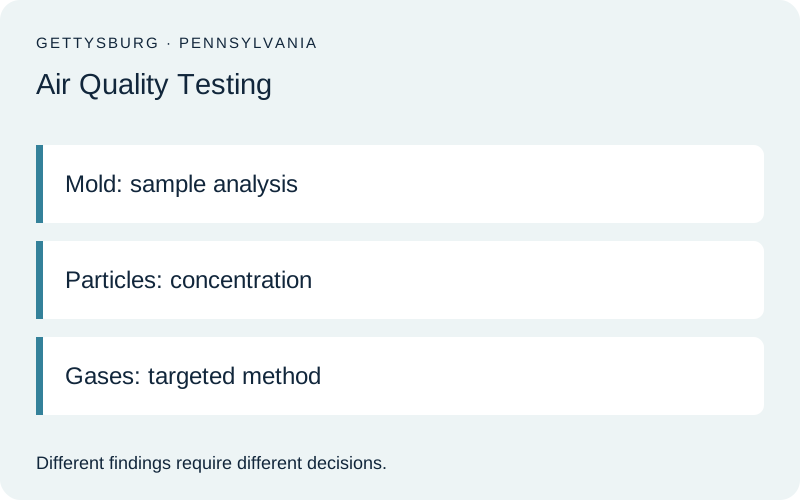
It measures only the pollutants or conditions included in the chosen method, such as airborne mold particles, particulate matter or a specified gas.
| Concern | Appropriate investigation | What it does not establish |
|---|---|---|
| Suspected mold linked to dampness | Building and moisture inspection; targeted sampling if useful | A diagnosis of a person’s symptoms |
| Visible growth on a wall | Assess the material and moisture; sampling often unnecessary | That the rest of the building is unaffected |
| Dust or smoke particles | A suitable particle-monitoring method | Mold species or hidden growth |
| Chemical odor or VOC concern | A specifically designed chemical investigation | A complete assessment from a mold sample |
| Radon or carbon monoxide | Dedicated testing or detection for that gas | Detection by an ordinary mold sample |
Our service scope focuses on mold-related building concerns. Do not assume VOC, asbestos, radon or combustion-gas testing is included. Those require an appropriate specialist and method. A carbon monoxide alarm or suspected gas emergency needs an immediate emergency response, not a scheduled mold visit.
Do you always need an air test when you see mold?
No. Visible mold usually does not require sampling before deciding that the moisture and affected material need attention.
The Environmental Protection Agency’s mold testing guidance explains that sampling is often unnecessary when growth is visible. Testing is more useful when it answers a defined question that changes the investigation or agreed verification.
The CDC’s National Institute for Occupational Safety and Health does not recommend routine air sampling for damp-building evaluations. Short samples can miss an intermittent condition. Our mold inspection service focuses on the building; this page focuses on sampling, analysis and interpretation when those are justified.
How is mold air sampling carried out?
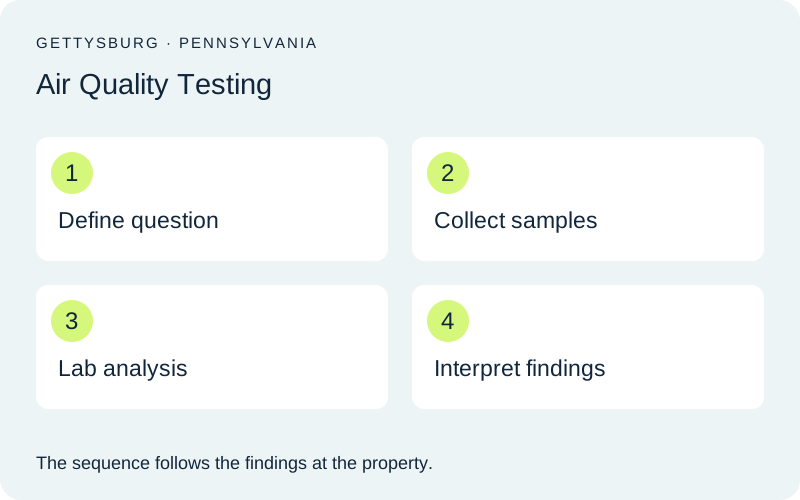
A sampling plan defines the purpose, locations, collection method, conditions and interpretation before samples are collected.
- Define the question. Identify the concern that the result is intended to inform.
- Plan the locations. Select relevant indoor locations and any comparison samples the investigation requires.
- Record collection conditions. Document the sample identifiers, method, volume or duration, and relevant site conditions.
- Analyze and interpret. Review laboratory findings alongside the inspection and state the limits of the conclusions.
A spore-trap method collects airborne particles for laboratory examination; the method and sample volume must be recorded. Outdoor comparison samples can provide context but are not a universal pass/fail standard. Weather, open windows, HVAC operation and recent disturbance can affect how a snapshot should be interpreted. Preparation instructions should come from the sampling professional rather than an attempt to make the result look better.
What should a useful air quality report tell you?
It should connect identifiable samples and methods with the building observations, results, limitations and the action those findings support.
| Report item | Purpose | Common interpretation error |
|---|---|---|
| Sample location and identifier | Connect the result to a specific collection point | Treating one room’s sample as the whole home |
| Method, volume and units | Show what was collected and how it is expressed | Comparing numbers produced by different methods as equivalents |
| Site and reference conditions | Explain the context at the time of collection | Treating an outdoor comparison as a health threshold |
| Laboratory findings | Describe the submitted samples | Assuming a count locates a hidden source |
| Limitations and recommendations | State what the evidence supports next | Calling a low result proof that every cavity is clean |
A result reported as spores per cubic meter is a concentration for the sample method and collection period. It is not a medical diagnosis. EPA notes that no federal mold or mold-spore limits have been established for a universal compliance test.
How much does indoor air quality testing cost?
$303 to $616 per project, with a $443 average, is HomeAdvisor’s published national indoor air quality testing benchmark.
The June 19, 2026 cost report was checked September 25, 2026. These figures cover varied US testing scopes, not a Gettysburg price or a guaranteed mold-testing package. The number of locations, method, laboratory work and reporting affect the fee.
Sampling and cleanup are separate services. Before booking, our quote identifies the proposed assessment, any agreed samples and reporting. Tests for additional pollutants are not automatically included.
Can a home air-quality monitor detect mold?
A consumer particle or VOC reading does not identify mold species or establish whether a wall contains hidden growth.
A monitor can track the conditions its sensors measure, such as PM2.5 particle levels or a sensor response to volatile organic compounds (VOCs). That can be useful for patterns, but a low reading does not clear damp materials. EPA’s guide to low-cost air monitors explains that devices measure particular pollutants and have performance limitations.
Example, not a customer case: a room has a low particle reading but a damp wall behind a cabinet. The next useful step is to investigate the wall and leak history. Adding a second general-purpose monitor does not answer the concealed-material question.
Is air testing the same as post-remediation verification?
No. Verification reviews whether the agreed remediation objectives were met; sampling may be one part of that review when specified.
Cleaned surfaces, moisture correction and accessible material condition remain important. A test by itself cannot establish whether the cause was fixed. Arrange any independent assessment before the project closes, with the evaluator and scope clearly identified.
See post-remediation verification for completion review, or musty odor investigation if the unresolved concern is a returning smell.
What else should you know before arranging air testing?
Choose the method around a specific building question, and interpret every result with its sampling limitations.
Can a test certify that my home is mold-free?
No. Mold spores occur naturally, and a limited set of samples cannot prove the absence of mold everywhere. A report should define the areas assessed and what the evidence supports. It should not promise a universal health clearance for every occupant.
How long do results take?
The collection visit and laboratory turnaround are separate. The method, lab and reporting scope determine the schedule, which is confirmed when testing is arranged. Do not delay stopping an active leak or restricting access to an affected work area while awaiting laboratory results.
Should every room be sampled?
Not automatically. Sample locations should serve the investigation rather than a fixed room count. More samples can add cost without resolving the question if the source is a concealed damp material. The sampling plan should explain why each location is relevant.
Can an air test explain my symptoms?
A building test cannot diagnose a medical condition or establish an individual’s cause of symptoms. Discuss health concerns with a healthcare professional. The building investigation addresses moisture, materials and the specific pollutants included in its scope.
For cleanup that extends beyond this service, our Gettysburg mold remediation services connect the affected areas with a property-specific plan.
How do you arrange air quality testing in Gettysburg?
Call (844) 578-3055 or use the quote form to request an assessment for your property. We confirm the service scope, fees and availability before work is agreed.
Include the affected location and any visible growth, moisture or odor. For an older home in historic Gettysburg, mention access restrictions and original materials that need consideration. Service availability is confirmed for the property address in Gettysburg or Adams County.