
Why does mold grow on a bathroom ceiling?
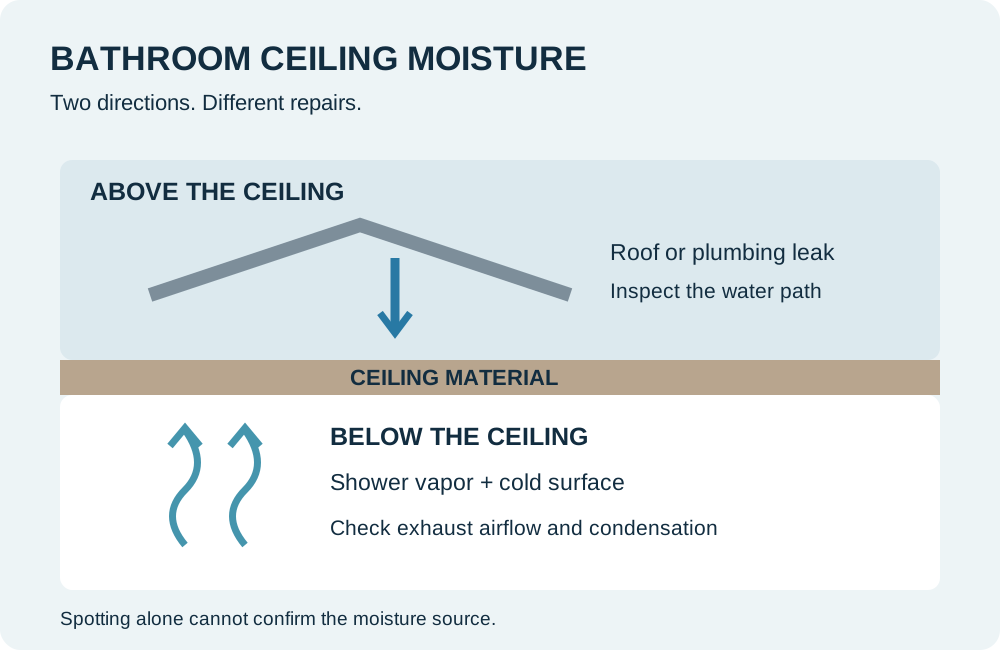
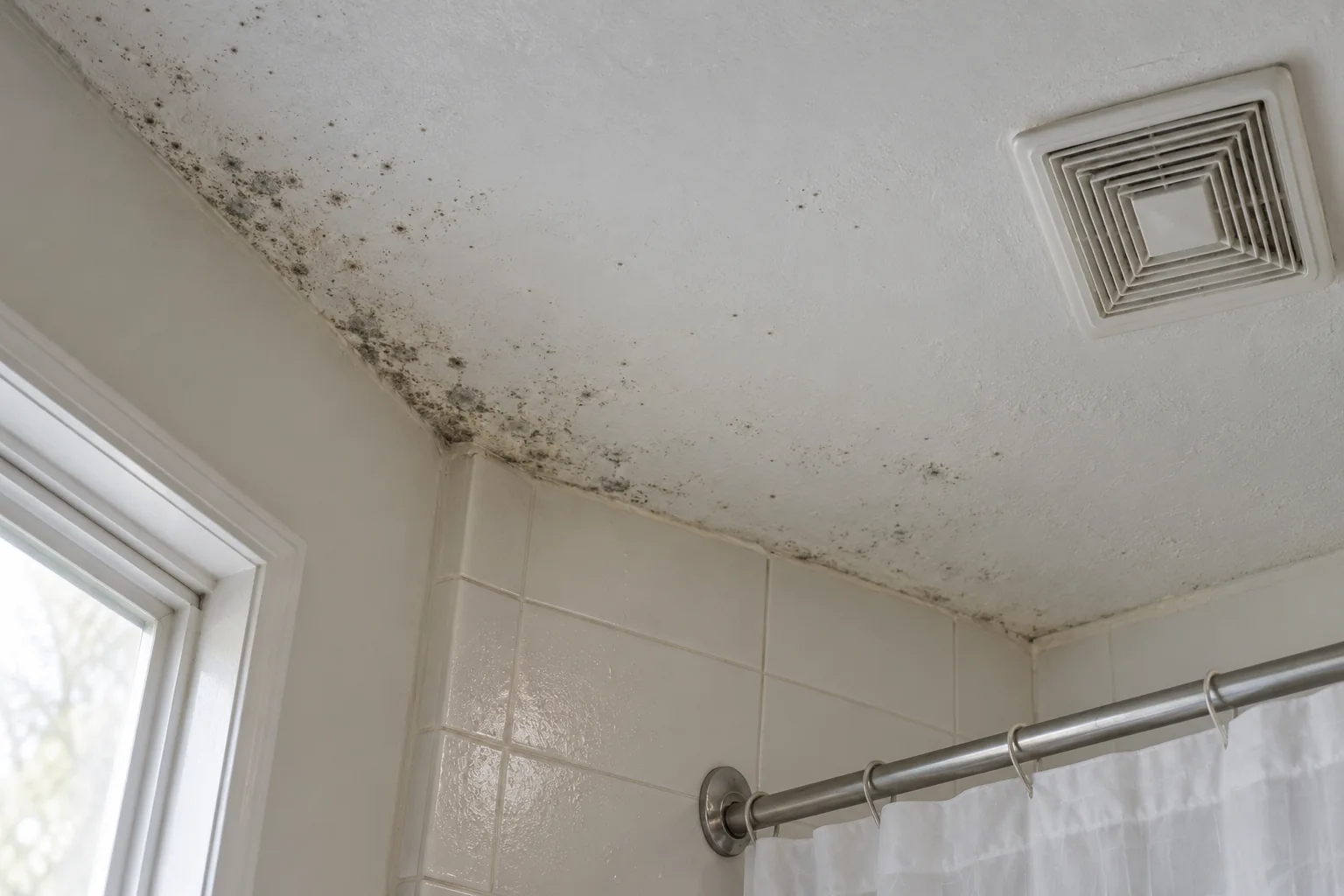
Bathroom ceiling mold grows when condensation or a leak keeps the ceiling surface or backing damp. Shower vapor supplies moisture from inside the room. Roof leaks and plumbing leaks supply water from above. A cold ceiling increases the chance that humid room air will condense on its surface.
Bathroom ceiling spotting needs a moisture assessment before another coat of paint. A bathroom with a running fan still needs a clear exhaust route outdoors. A localized stain also needs investigation beyond the visible paint.
Is bathroom ceiling moisture coming from below or above?
Bathroom ceiling moisture after showering points toward condensation, while fresh wetness after rain or upstairs plumbing use points toward a leak. Timing narrows the investigation. Timing does not establish a diagnosis.
| Observed pattern | Possible moisture path | What needs checking |
|---|---|---|
| Droplets after showers | Room humidity condenses on a cold ceiling | Fan airflow, operating time and ceiling temperature |
| Fresh stain after rain | Roof or flashing leak above the bathroom | Roof penetration and wet materials above the stain |
| Wetness after an upstairs fixture runs | Supply, drain or fixture leak | Plumbing route and concealed ceiling damage |
| Cold-weather spotting at corners | Cold surfaces, insulation gaps or air leakage | Ceiling insulation continuity and air sealing |
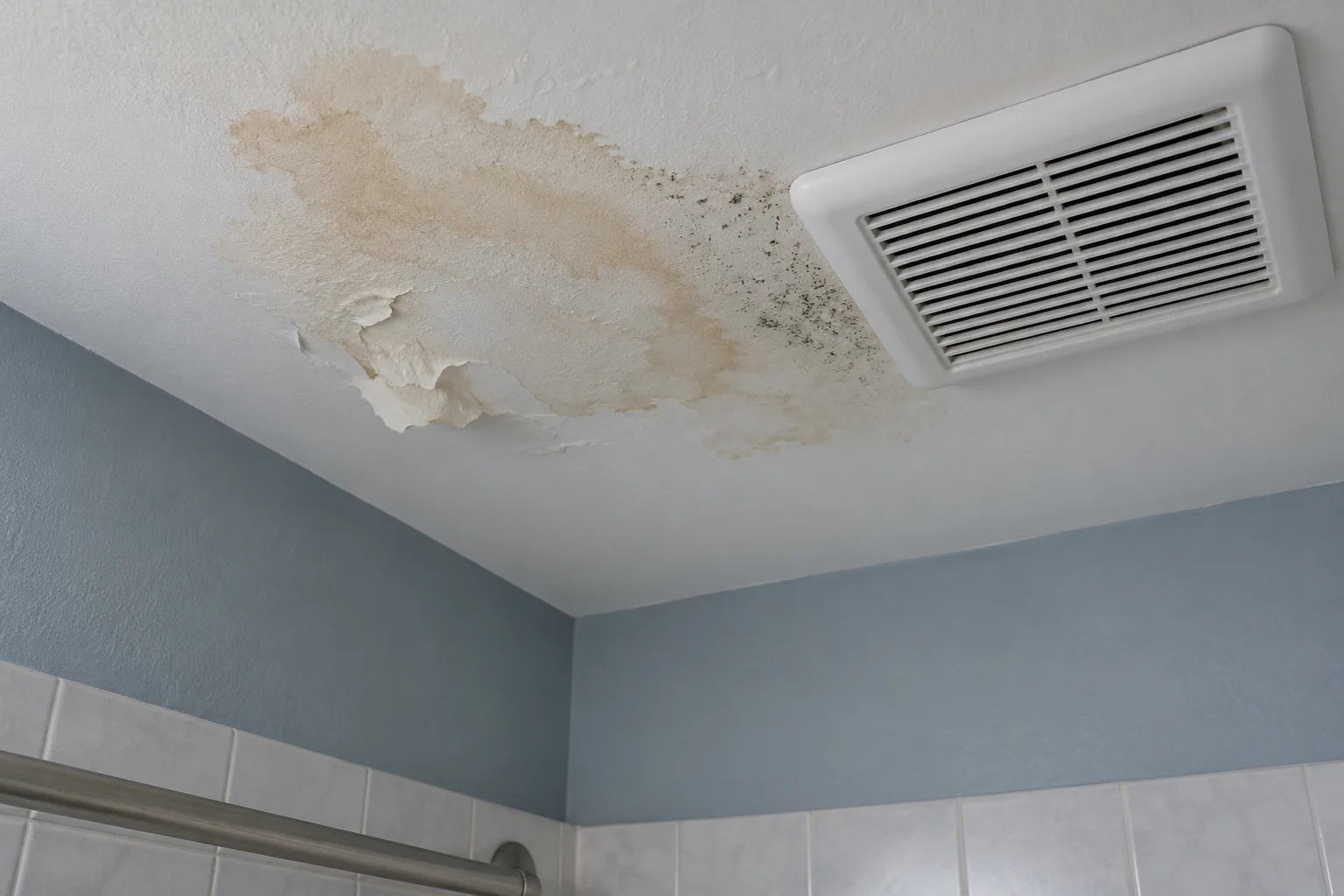
| Water around the exhaust grille | Duct condensation, an exterior vent leak or another nearby source | Duct insulation, connections and exterior termination |
Ceiling inspections should follow the moisture path beyond the darkest patch. Water can travel along building materials before reaching the visible stain. A dry surface reading after several dry days does not rule out an intermittent leak.
How long should a bathroom exhaust fan run?
Bathroom exhaust fans should run during showers and for at least 20 minutes afterward under Home Ventilating Institute guidance. A timer supports consistent operation. Persistent condensation needs further investigation even when the timer completes its cycle.
Bathroom fan sizing under HVI ventilation guidance uses 1 CFM per square foot for bathrooms under 100 square feet, with a minimum of 50 CFM. An 8-by-10-foot bathroom therefore has an 80-CFM sizing benchmark. HVI guidance is not a determination of Gettysburg building-code compliance.
Bathroom fan runtime recommendations differ between sources. PNNL's bathroom exhaust guide recommends one hour after a shower for humidity control. Neither timer setting guarantees a dry ceiling when airflow is restricted or water enters from above.
- Exterior discharge: the exhaust duct must carry moisture outside the home, not into the attic or ceiling cavity.
- Airflow: an installer should check delivered airflow rather than infer performance from fan noise.
- Duct condition: crushed ducts, unnecessary bends and obstructed outlets restrict extraction.
- Cold duct surfaces: duct insulation reduces condensation in unconditioned space.
Attic contamination from misplaced exhaust belongs in an attic mold removal assessment that also addresses the discharge route. Fan replacement alone leaves existing contaminated materials untreated.
Can bathroom ceiling mold be cleaned without replacing the ceiling?
Bathroom ceiling mold on a sound, cleanable finish may be removable, while deteriorated or deeply affected porous material needs a replacement assessment. The ceiling material and the extent of damage determine the approach.
| Ceiling condition | Appropriate focus | Limit of surface cleaning |
|---|---|---|
| Intact hard, washable surface | Compatible cleaning and complete drying | Cleaning does not correct the moisture source |
| Soft, swollen or crumbling drywall | Professional assessment of affected board and cavity | The visible finish does not reveal the full damage |
| Moldy absorbent ceiling tile | Removal and replacement assessment | Porous material may retain growth beyond its surface |
| Fragile textured finish | Identify the finish before disturbing it | Scrubbing or scraping can damage the coating |
EPA's household mold cleanup guidance treats less than about 10 square feet as a size many homeowners can handle in most cases. Significant water damage, contaminated water, hidden growth and unsafe overhead access require a different decision. The size threshold does not certify a damaged ceiling as safe for DIY cleaning.
Hard-surface cleanup uses detergent and water followed by complete drying under EPA guidance. Cleaning products need use according to their labels. Cleaning chemicals must never be mixed. Overhead cleanup requires eye protection, gloves and suitable respiratory protection.
Damaged gypsum needs a mold on drywall assessment that distinguishes surface contamination from affected paper facing and concealed damage. A sagging ceiling needs prompt professional assessment without pressing or cutting the weakened area.
Will mold-resistant paint stop bathroom ceiling mold returning?
Mold-resistant paint does not repair a leak or remove existing mold. Repainting belongs after moisture correction, cleanup and drying.
EPA's mold and moisture guidance advises against painting over moldy surfaces. Bathroom paint selection should follow the coating manufacturer's requirements for the actual substrate. Repeated growth after repainting warrants investigation of the original moisture source.
Bathroom humidity control reduces the moisture available for regrowth. CDC recommends indoor relative humidity no higher than 50%. A hygrometer measures room air, while a moisture assessment checks the ceiling material. A room-air reading cannot establish that hidden board or insulation is dry.
Is black mold on a bathroom ceiling dangerous?
Bathroom ceiling mold may cause allergic or respiratory symptoms, but black color does not establish the species or a person's health risk. CDC describes different health responses to damp and moldy environments.
People with asthma, mold allergies, immune suppression or chronic lung disease need particular care around mold exposure. A healthcare professional should assess health concerns. CDC's mold guidance prioritizes removing growth and correcting moisture without first identifying the mold type.
When does bathroom ceiling mold need professional help?
Bathroom ceiling mold needs professional assessment when growth recurs, ceiling material deteriorates, concealed damage is suspected or access is unsafe. A roof or plumbing leak also needs the appropriate repair specialist.
Gettysburg Mold Remediation Help provides a free referral service for bathroom mold removal in Gettysburg when a property needs assessment. The independent company determines the affected materials, prices the work and performs the service.
Gettysburg Mold Remediation Help connects homeowners seeking mold remediation referrals in Gettysburg, PA with independent companies for property-specific assistance.