
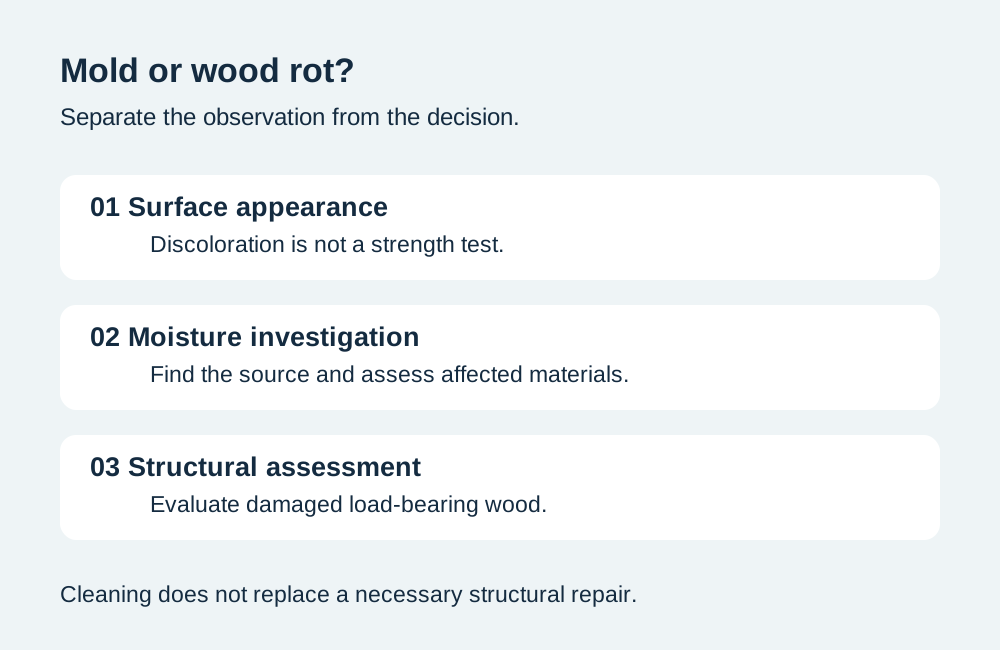
How does mold differ from wood rot?
Wood rot breaks down the components that give timber strength. Mold growth and discoloration do not, by themselves, establish structural decay. Mold and decay fungi can share a damp location. A stained board therefore needs a condition assessment before a repair decision.
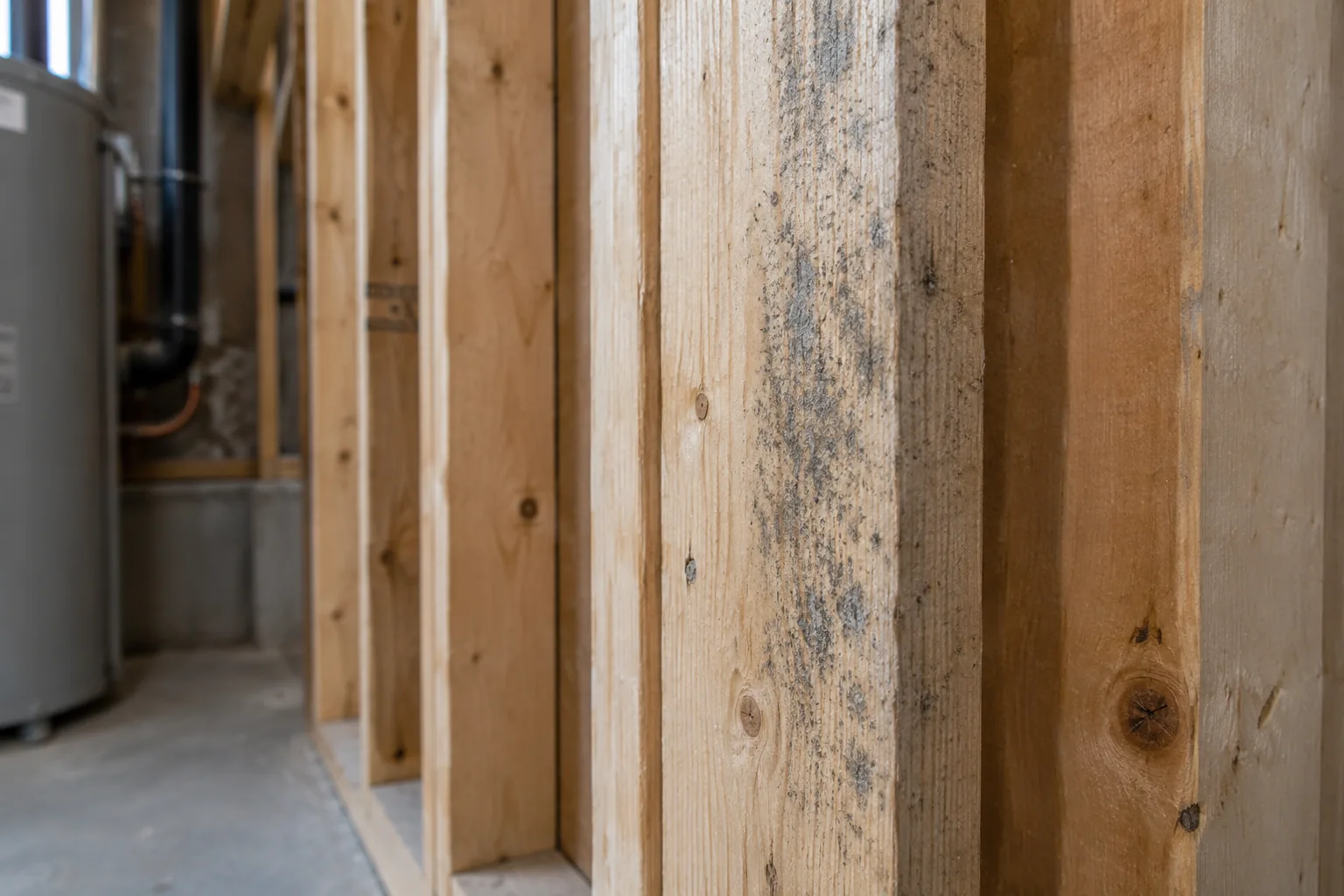
USDA's Wood Handbook, chapter 14 distinguishes molding, staining and decay. Mold discoloration often appears at the surface. Fungal penetration can extend deeper. Decay fungi consume structural components such as cellulose. A clean-looking surface does not certify sound wood.
| Observation | Possible meaning | Assessment needed |
|---|---|---|
| Dark spots on otherwise intact grain | Surface growth or staining | Moisture source, affected extent and material condition |
| Crumbly wood or loss of the original edge | Deterioration beyond discoloration | Depth of damage and the member's structural role |
| Floor movement or visible sagging | A support or assembly problem | Structural assessment, not a diagnosis from color |
| Musty smell with no visible damage | A reason to investigate damp materials | Moisture investigation rather than a species guess |
Can mold and wood rot occur together?
Mold growth and wood decay can occur in the same moisture-damaged assembly. A repair plan should separate contamination removal from the evaluation of timber strength. Completing one task does not certify completion of the other.
A bathroom leak investigation should include the subfloor, adjacent framing and the route of water entry. A crawl space investigation should distinguish exposed board faces from joist ends and connections. A window investigation should include the sill and concealed adjacent materials where access is necessary.
Wall finishes can conceal the affected assembly. The guidance on mold in drywall and wall cavities explains why the visible face does not define the entire repair area.
What does wood rot look like compared with mold?
Advanced wood rot can produce crumbling, cross-grain cracking or a bleached, fibrous appearance. Early decay can be difficult to recognize. Surface color alone cannot establish the cause or the remaining strength.
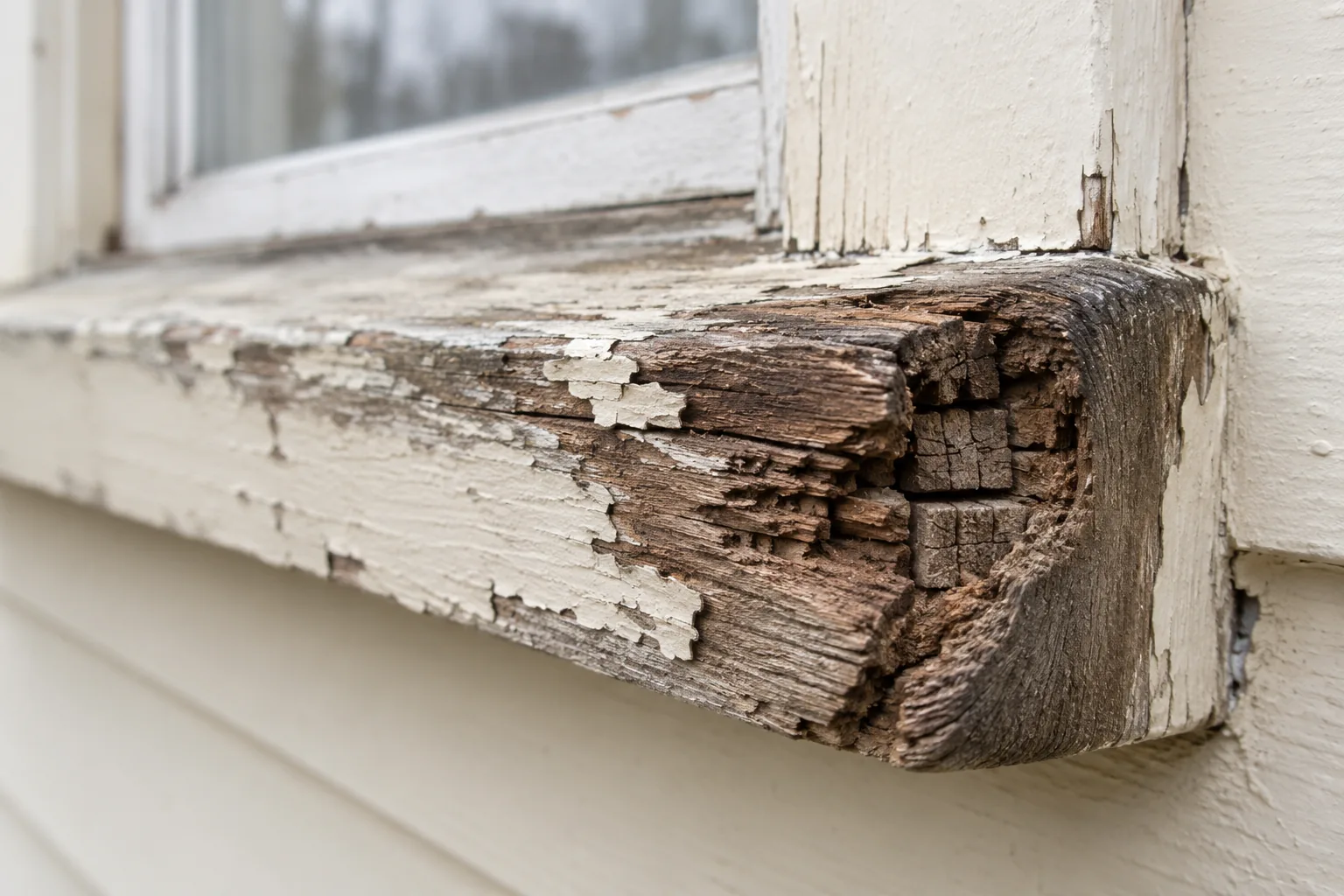
Wood photographs are useful for recording a location and tracking visible change. A photograph cannot establish damage depth, connection condition or the load carried by a member. An inspection should record those limitations instead of assigning a safe or unsafe label from an image.
Black discoloration is not a laboratory identification. A photographic resemblance should not become a named species claim or a prediction of health effects. A visibly damaged sill also does not prove that every neighboring stud needs replacement.
Does a dry moisture reading mean the wood is sound?
A dry moisture reading does not prove that previously damaged wood retains its strength. A moisture reading describes the measured condition at a location. A structural assessment addresses the member's ability to perform its job.
APA's wood-panel moisture guidance identifies prolonged moisture contents around 20% to 25% or higher as conditions associated with mold and decay. APA also explains that some swelling or flaking does not reduce panel capacity after drying. Visible swelling alone is therefore not a replacement specification.
| Evidence | Useful purpose | Unsupported conclusion |
|---|---|---|
| Wood moisture content | Locate wet material and document drying | A low reading restores lost strength |
| Room relative humidity | Track moisture in the air | Room humidity equals wood moisture content |
| Surface photograph | Record discoloration and visible deterioration | The image proves a species or load capacity |
| Removal of visible growth | Document a cleanup step | Cleaning certifies the supporting structure |
Dry rot still requires a moisture supply during active decay. USDA explains that some decay fungi transport water through strands. The name does not mean that permanently dry wood can decay without water.
When should a structural professional assess the wood?
Suspected decay in a beam, joist, post or other load-bearing member warrants assessment by a qualified structural professional. Visible sagging, loss of support or unstable flooring calls for restricted access until the condition has been evaluated. Do not test a questionable floor by walking or bouncing on it.
- A structural engineer evaluates load-bearing members and specifies necessary structural repairs.
- A mold remediation professional addresses contamination and affected materials within an agreed scope.
- A repair contractor performs the specified material replacement and moisture-source repairs.
A damaged decorative trim piece and a damaged support post have different repair consequences. The repair of mold-affected building materials should follow the assessment of each component rather than a single treatment for every wood surface.
Can cleaning or drying replace wood repair?
Cleaning and drying do not replace a necessary structural repair. The repair sequence should address immediate stability, stop wetting, remove contamination and restore damaged components. The responsible professionals should coordinate access and the order of work.
EPA's household mold guidance recommends drying water-damaged materials within 24 to 48 hours. EPA recommends fixing water problems alongside cleanup. EPA also advises against painting over moldy surfaces. A coating should not conceal an unresolved moisture problem.
Gettysburg Mold Remediation Help offers a free referral service for mold remediation assessment in Gettysburg through independent companies. The independent company assesses the property, prices the work and performs the service. Structural engineering needs should be identified separately when damaged framing is involved.