
Does mold under flooring require replacing the entire floor?
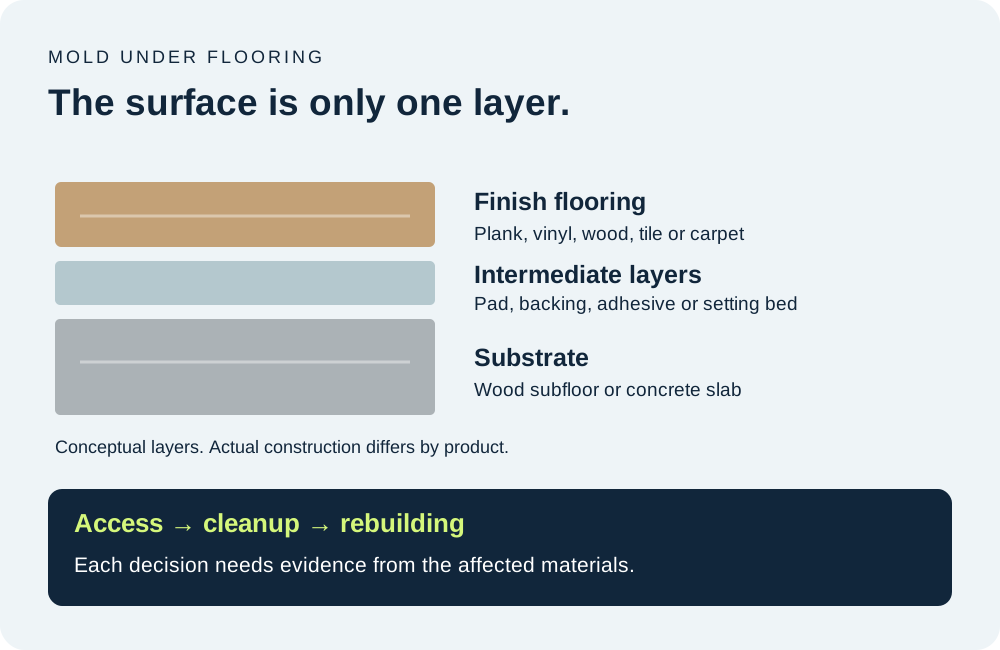
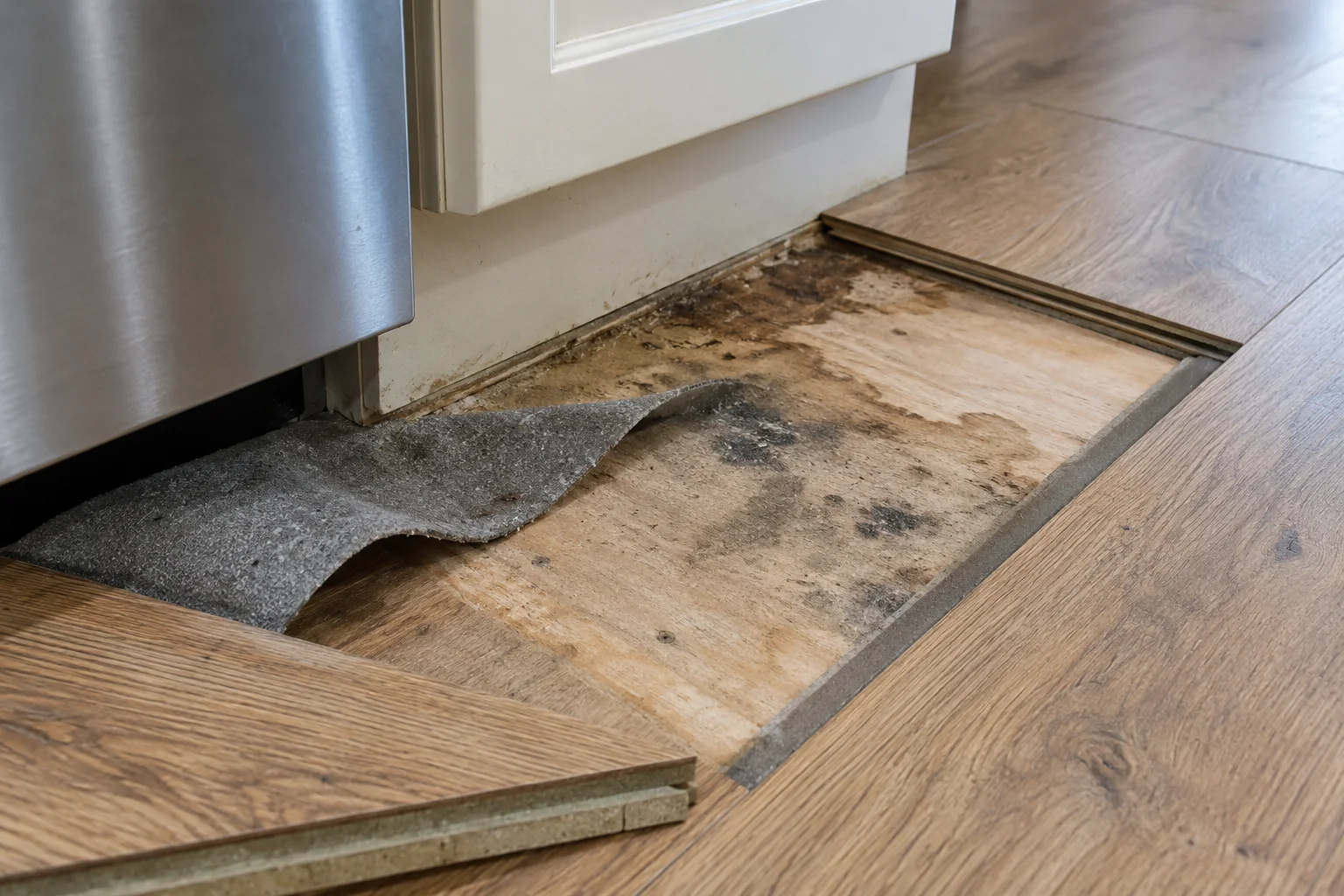
Mold under flooring requires assessment of the affected layers before deciding what to remove. A clean-looking finish does not establish the condition of the backing, adhesive or subfloor. Whole-room replacement needs a reason beyond the first visible stain.
Floor assessment should separate access from disposal. An intact plank might need lifting to reach contamination beneath it. A damaged plank might need replacement even after the contamination is removed. Reinstallation also requires usable joints and compliance with the flooring product's instructions.
| Floor finish | Concealed materials to identify | Repair decision |
|---|---|---|
| Laminate | Plank core, attached or separate underlay, wood or concrete substrate | Evaluate swollen edges and damaged locking joints separately from surface contamination |
| Vinyl plank or sheet vinyl | Backing, pad or adhesive, underlying floor | Determine whether the affected underside is accessible and the product is reusable |
| Solid or engineered wood | Board undersides, fastening or adhesive system, subfloor | Assess board condition and retained substrate before refinishing or reinstalling |
| Ceramic or porcelain tile | Setting material, any membrane or backer board, substrate | Do not treat a washable tile face as proof that lower layers are clean |
| Carpet | Backing, cushion, tack strips, subfloor | Moldy porous materials may require disposal even when the surface has dried |
Floor assemblies differ by product and installation method. The table identifies assessment targets rather than prescribing a construction detail. Carpet-specific backing and cushion replacement decisions explain why surface cleaning alone does not resolve every carpet problem.
What are the signs of mold beneath a floor?
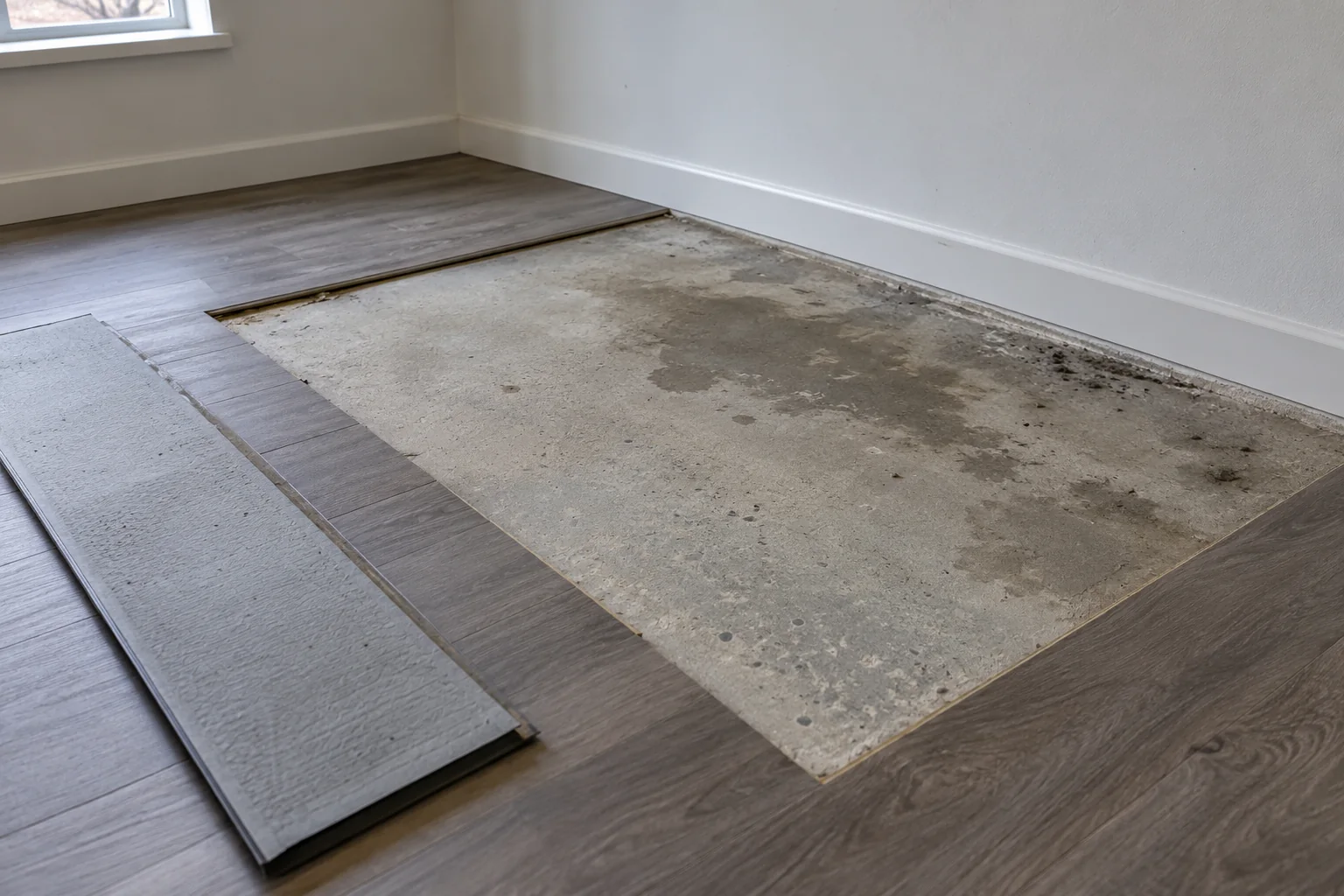
Signs warranting a hidden-mold investigation include persistent musty odor, visible growth at an exposed edge and a history of wetting. A stain or swollen joint alone does not prove mold. A photograph does not establish the affected depth.
- A musty odor concentrated near a cabinet or transition helps locate an investigation area.
- A previous appliance leak identifies a possible water pathway.
- New movement, swelling or a soft spot requires assessment of material condition.
- Visible spotting on an exposed underside identifies a surface for closer examination.
Mold color does not establish the species or a household health diagnosis. CDC's household mold guidance recommends correcting mold and moisture without waiting for species identification. CDC also advises against routine home mold testing.
How does moisture get underneath flooring?
Floor moisture can come from leaks, wet substrates or condensation. The investigation needs to identify the pathway before choosing a repair. New flooring does not correct the water source.
- Water from above: an appliance connection, plumbing leak or overflow can wet seams and perimeter layers.
- Moisture from below: a slab or crawl-space assembly needs its own moisture-control assessment.
- Condensation: humid air contacting a sufficiently cold surface can create wetting without a plumbing leak.
Moisture investigation should include the area around the first visible damage. EPA's remediation planning guidance requires assessment of continuing moisture and hidden sources. A repair plan should change when opening the assembly reveals a wider affected area.
Indoor humidity control supports prevention after source repairs. CDC recommends indoor relative humidity no higher than 50%. Room-air humidity does not establish the moisture condition inside concrete or wood.
Is lifting flooring safe when hidden mold is suspected?
Flooring with suspected asbestos, contaminated water or extensive hidden growth requires professional assessment before flooring is disturbed. Older resilient flooring, backing and adhesives need particular caution. Age or appearance alone cannot establish asbestos content.
EPA's asbestos guidance advises leaving suspect material undisturbed and using trained, accredited professionals for sampling. Sanding, scraping or breaking suspect flooring can release fibers. A mold cleanup plan does not replace an asbestos assessment.
Mold cleanup scope also matters. EPA's homeowner guide uses about 10 square feet as a cleanup-scope threshold. A small exposed patch does not establish the size of concealed growth. Sewage contamination requires an experienced professional.
Can mold under flooring be cleaned without removing the finish?
Cleaning beneath flooring requires access to the affected surfaces and a workable drying path. Surface mopping does not clean a concealed underside. Chemical treatment poured through seams does not demonstrate that the hidden layers have been cleaned.
EPA's clean-water damage table specifically includes cleaning and drying the subfloor. The 24-to-48-hour response window is a prevention guideline, not a guaranteed mold-free deadline. Established growth or longer wetting requires a different remediation assessment. Fans should not be used before the water is determined to be clean or sanitary.
Hard surfaces are generally cleaned with detergent and water under EPA's mold course guidance. Moldy porous materials may be impossible to clean completely. Removal methods should limit the spread of contaminated debris.
Subfloor retention also requires a structural decision. Softness, separation or loss of support warrants assessment by a qualified building professional. Cleaning does not restore lost strength. The repair of mold-damaged flooring and building materials follows the cleanup and drying work.
How dry must a subfloor be before new flooring is installed?
A subfloor must meet the selected flooring and adhesive manufacturers' moisture limits before installation. A universal 15% or 16% pass value is inappropriate for every material. A measurement needs a named material, a test method and the applicable product limit.
Shaw's residential direct-glue resilient flooring instructions specify internal relative-humidity testing for concrete. Shaw also refers installers to adhesive-specific acceptable moisture limits. The instructions apply to that flooring system rather than every floor product.
| Measurement | Material assessed | Installation decision |
|---|---|---|
| Wood moisture content | A named wood component with a suitable instrument | Use the selected wood-flooring system's requirements |
| Concrete internal relative humidity | Humidity measured inside concrete under ASTM F2170 | Compare with the flooring and adhesive limits for that method |
| Concrete vapor-emission test | Surface moisture vapor emission under ASTM F1869 | Use only where accepted by the product instructions |
| Room relative humidity | Moisture in indoor air | Supports environmental control, but does not clear a wet subfloor |
Floor reconstruction should follow source correction, completed cleanup, a sound substrate and acceptable installation measurements. Shaw notes that moisture tests describe conditions at the time of testing. An unrepaired recurring leak invalidates the assumption that one dry reading solves the problem.
Gettysburg Mold Remediation Help provides a free referral service for mold assessment and removal for Gettysburg properties through independent companies. The independent company assesses the floor, prices the proposed work and performs the service.