
Can leather with mold be saved?
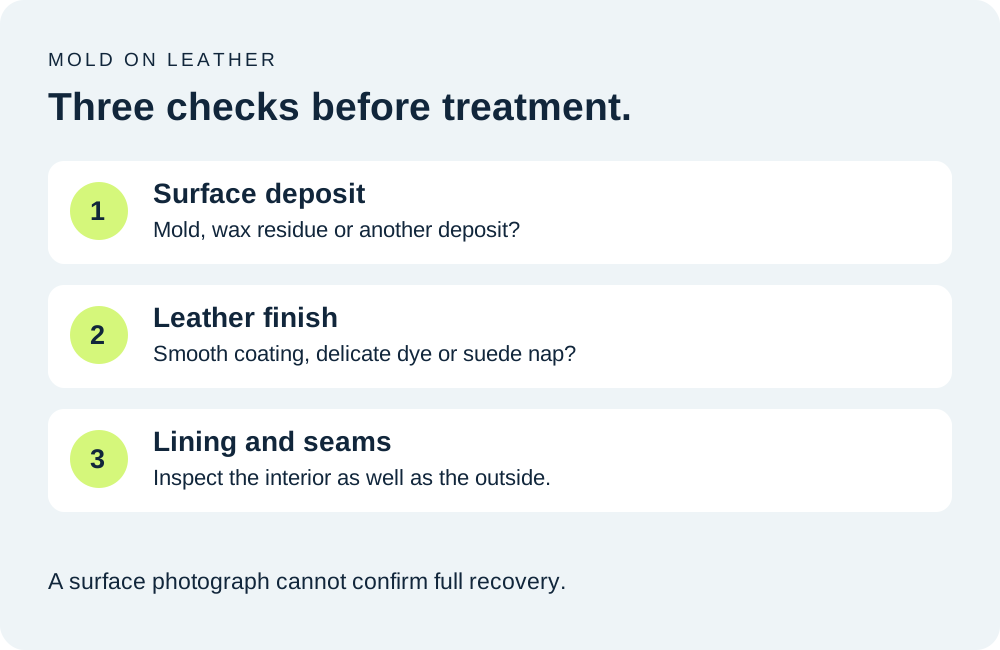
Leather with limited surface mold may be recoverable when the material remains sound and the affected surfaces are accessible. Mold inside a lining, weakened stitching or a damaged finish changes that decision. A clean-looking exterior does not establish that the whole item is ready for use.
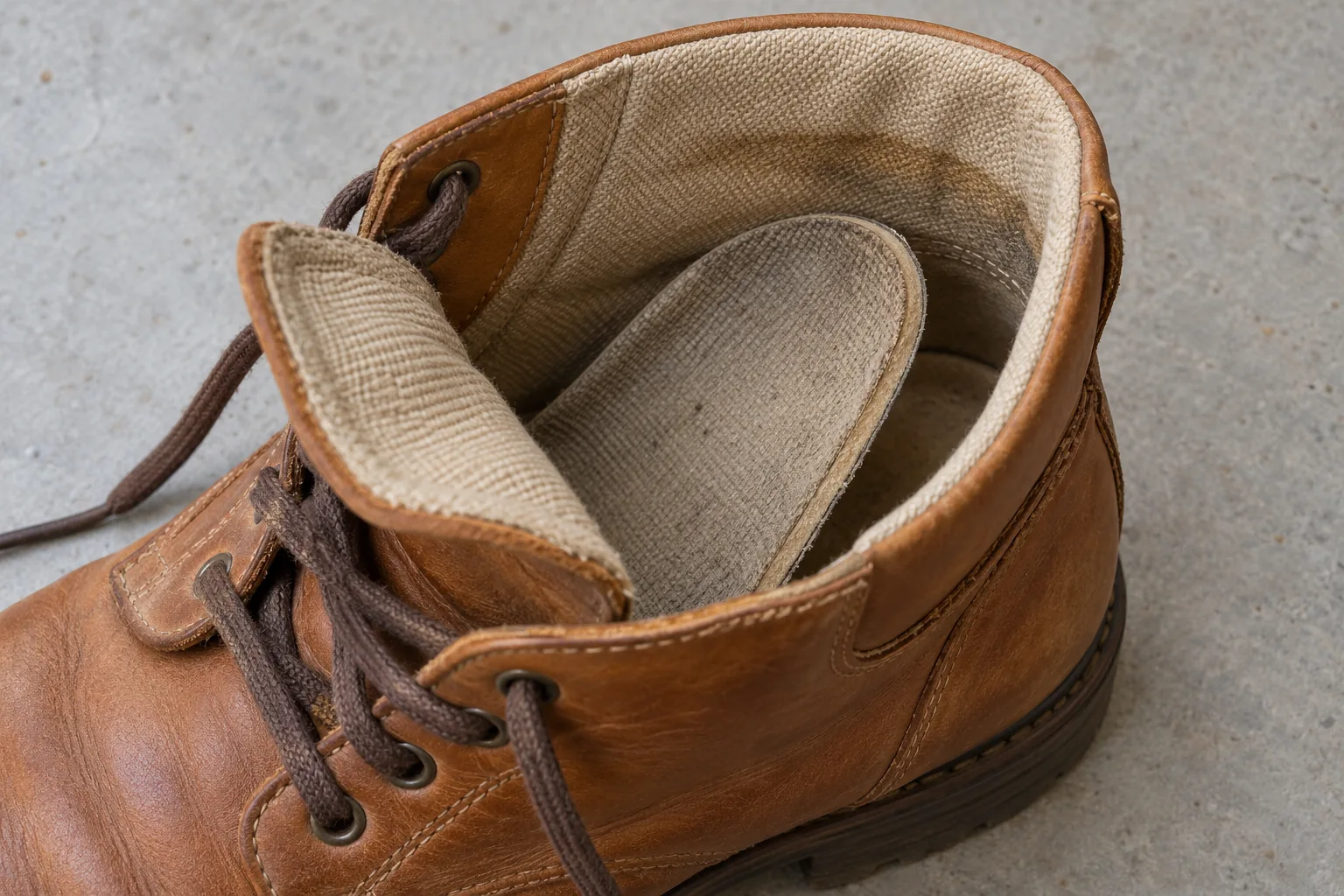
Leather recovery starts with separating the deposit, the surface finish and the interior construction. A handbag with an accessible flap presents a different problem from a boot with a fixed textile lining. A professional leather cleaner handles modern goods, while a conservator assesses fragile or historically important objects.
Is white powder on leather always mold?
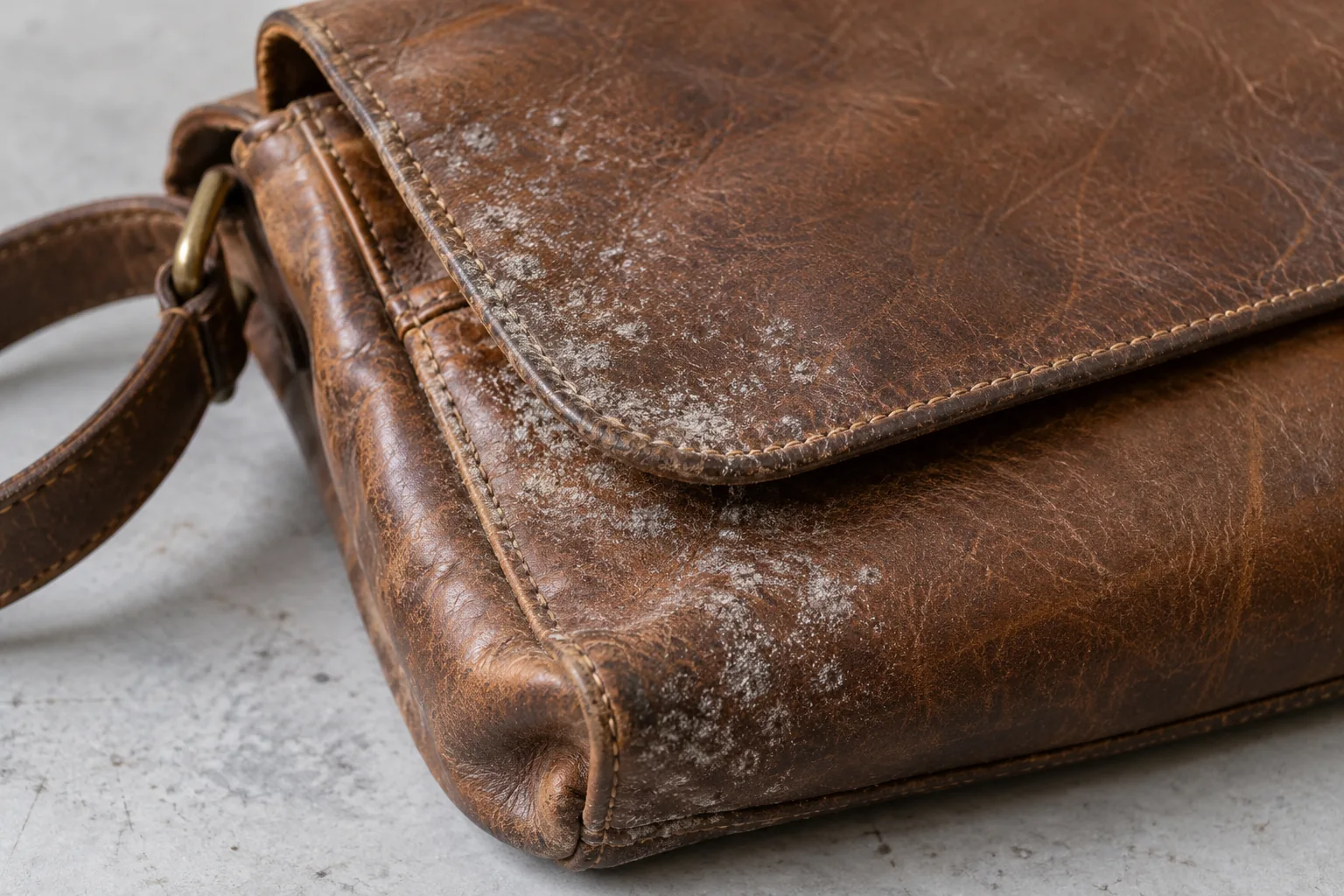
White powder on leather is not always mold. Waxes, fatty deposits, salts and surface dirt can produce light-colored marks. The National Park Service explains these lookalikes in its leather bloom guidance, including cases where photographs do not resolve the identification.
Leather treated with oils or dressings can develop fatty acid spew, a waxy surface bloom. Mold and fatty deposits can also occur on the same object. A recurring white patch therefore deserves reassessment rather than repeated treatment with a stronger cleaner.
| Observation | Possible explanation | Practical response |
|---|---|---|
| Light deposits after damp storage | Possible mold, residue or a combination | Limit handling and investigate the storage conditions. |
| Waxy bloom on previously dressed leather | Fatty acid spew is one possibility | Have the deposit identified before adding more oil. |
| Permanent dark marks after cleaning | Staining or finish damage may remain | Evaluate the material condition instead of chasing color alone. |
| Flaking, brittleness or loose stitching | Physical deterioration needs a separate assessment | Support the item and stop abrasive cleaning. |
Leather photographs document the location and extent of a change. Leather photographs do not identify a mold species, establish toxicity or prove that a residue is harmless.
Does the leather finish change the cleaning method?
The leather finish changes which cleaning products and handling methods are appropriate. Smooth coated leather, delicate dyed leather and suede should not receive one universal treatment. The item's care label or manufacturer specification is the starting point for modern goods.
| Material or construction | What needs attention | Decision before cleaning |
|---|---|---|
| Smooth finished leather | Coating condition, seams and existing damage | Confirm a compatible method for the exact product and finish. |
| Aniline, painted or delicate dyed leather | Color stability and surface changes | Use a specialist assessment when the finish is unknown or fragile. |
| Suede or nubuck | Raised surface texture and product compatibility | Do not transfer a smooth-leather cream or treatment automatically. |
| Lined boots, bags and jackets | Textile lining, pockets, seams and inserts | Assess each accessible component rather than only wiping the exterior. |
| Antique or valuable leather | Historic finishes, previous treatments and weakened structure | Consult a conservator before wet cleaning, dressing or reshaping. |
Leather-care products have material exclusions. La-Z-Boy's manufacturer product guidance excludes suede and nubuck from its protection cream. A product's suitability for routine care does not establish effectiveness against mold.
What should happen before mold is removed from leather?
Mold-affected leather should be isolated from clean belongings and assessed for dampness before treatment. The Canadian Conservation Institute's leather mold-removal guidance separates dry objects from wet objects because enclosed damp material needs prompt attention.
- Separate the item: prevent contact with unaffected belongings during assessment and transport.
- Check moisture: arrange prompt controlled drying for damp leather rather than leaving it sealed and wet.
- Identify the construction: locate the lining, pockets and sensitive decorative parts without forcing stiff folds.
- Choose the recovery route: establish whether accessible surface cleaning, component replacement or conservation is appropriate.
Leather mold removal requires control of released particles. CCI describes careful removal with a HEPA-filtered vacuum and controlled suction for vulnerable components. A household vacuum without appropriate filtration is not an equivalent method.
Leather with smearing deposits needs reassessment before further brushing. CCI notes that smearing may indicate insufficient drying. A conservator should direct treatment of fragile objects rather than applying a household cleaning sequence.
Should vinegar, alcohol, bleach or conditioner be used on moldy leather?
A universal vinegar, alcohol or bleach recipe is not appropriate for every leather finish. A cleaner needs compatibility with the specific item. Mold removal also requires physical cleaning and moisture correction, rather than relying on a claim that a chemical kills spores.
Leather solvents can affect dyes and finishes. CCI's leather conservation guidance explains how processing and finishing change a material's resistance to water and chemicals. An unknown finish deserves assessment before a test product is applied.
Leather conditioner is not a mold-remediation treatment. Routine dressing of historic leather can introduce further problems. The National Park Service distinguishes conservation of museum objects from maintenance of working items such as boots and saddles. A modern item's care instructions should not be transferred to an antique.
Leather drying also needs restraint. La-Z-Boy's leather care instructions warn against intense heat and prolonged direct sunlight. A hair dryer or sunny windowsill is not a substitute for controlled drying.
Does a remaining stain mean mold removal failed?
A remaining leather stain does not by itself prove that mold remains active. Mold damage, absorbed residues and altered finishes can leave visible changes after cleaning. A new deposit, renewed dampness or persistent odor still requires investigation.
Mold can cause deterioration and staining of organic collection materials, according to the National Park Service's collections guidance. Cosmetic improvement and material recovery are separate outcomes. Repeated scrubbing to remove a dark mark can create a second problem by damaging a fragile surface.
Leather recovery should be judged against the original condition, the cleaning record and the corrected storage environment. A photograph of a cleaner surface cannot certify the condition of a concealed lining.
How can mold on stored leather be prevented?
Leather storage needs moisture control, dry surroundings and protection from heat. EPA recommends indoor relative humidity below 60%, ideally 30% to 50%, in its household mold-prevention guidance. A humidity meter provides a useful check near the storage location.
Historic leather requires a more specific storage plan. CCI's tanned-leather care guidance recommends stable conditions and warns that very dry air below 30% RH can embrittle leather. Maximum dehumidification is therefore not a preservation goal.
- Leather belongings should return only to a dry storage area after the moisture source is corrected.
- Leather storage should avoid damp basement floors, sweating pipes and radiators.
- Leather items need support that avoids sharp folds and strain on brittle straps.
- Leather collections need regular inspection for new deposits and changes in material condition.
When does mold on leather need professional help?
Mold on valuable leather, inaccessible linings, fragile finishes or multiple stored items warrants professional assessment. A leather specialist evaluates the belongings. A building assessment addresses leaks or room conditions that keep exposing those belongings to moisture.
Mold exposure can cause reactions in sensitive people. CDC's cleanup guidance excludes people with mold allergies, immune suppression or underlying lung disease from cleanup work. Health concerns need advice from a healthcare professional.
Gettysburg Mold Remediation Help is a free referral service. Gettysburg Mold Remediation Help connects homeowners seeking assessment of mold-affected belongings with independent companies that assess recovery options and prices. Specialist leather conservation availability must be confirmed with the company.
Gettysburg Mold Remediation Help also connects homeowners with independent mold remediation companies in Gettysburg when the storage room or other building materials need assessment. The independent company determines the scope and performs the work.