
Does moldy insulation need to be replaced?
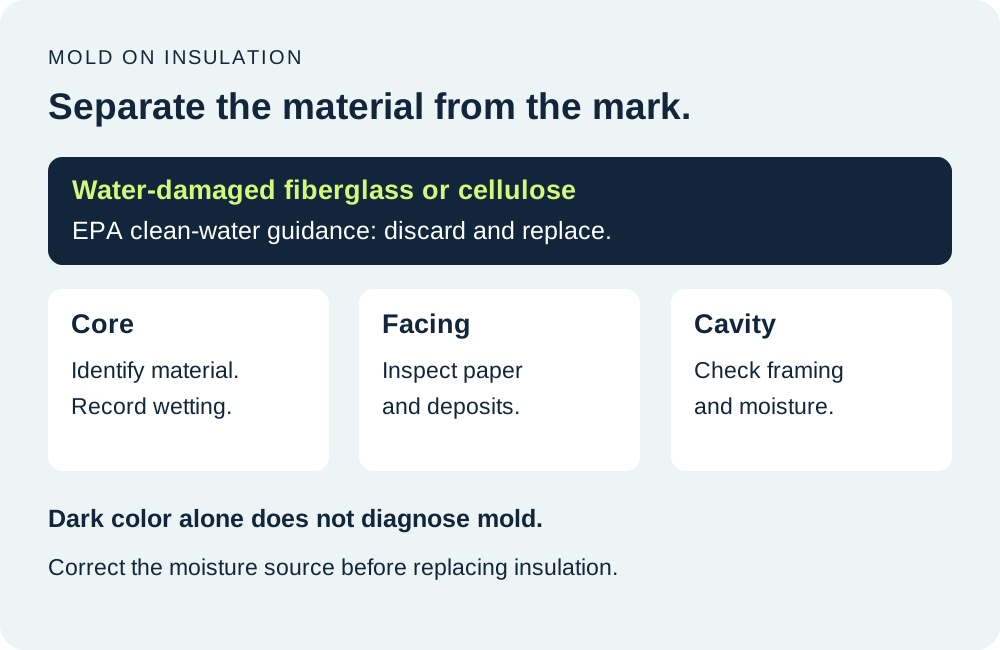
Water-damaged fiberglass and cellulose insulation should be discarded and replaced under EPA's clean-water response guidance. EPA's 24-to-48-hour water-damage table gives a replacement instruction for both materials. The drying window does not authorize washing a wet batt and reinstalling it.
Dry discoloration without a known water exposure needs a different assessment. Dark deposits alone do not establish mold contamination. A replacement decision should identify the insulation, the affected surface and the moisture history.
| Material or condition | Decision | Important distinction |
|---|---|---|
| Water-damaged fiberglass | Discard and replace under EPA guidance | A glass-fiber core does not make a contaminated batt reusable |
| Water-damaged cellulose | Discard and replace under EPA guidance | Drying does not override the material-specific replacement instruction |
| Dark, dry insulation with uncertain history | Investigate the deposit and moisture source before diagnosing mold | Color alone is insufficient evidence |
| Mineral wool, rigid foam or spray foam | Assess the product, contamination and surrounding assembly | The cited EPA table does not give a blanket salvage rule for these products |
| Suspected vermiculite | Leave the material undisturbed pending qualified advice | Potential asbestos changes the investigation and removal approach |
Can mold grow on fiberglass insulation?
Mold can affect deposits or organic materials associated with fiberglass insulation even though glass fibers are not a food source. NAIMA's material guidance distinguishes the inorganic insulation from organic matter on its surface. NAIMA represents insulation manufacturers, so the distinction should not be treated as a product guarantee.
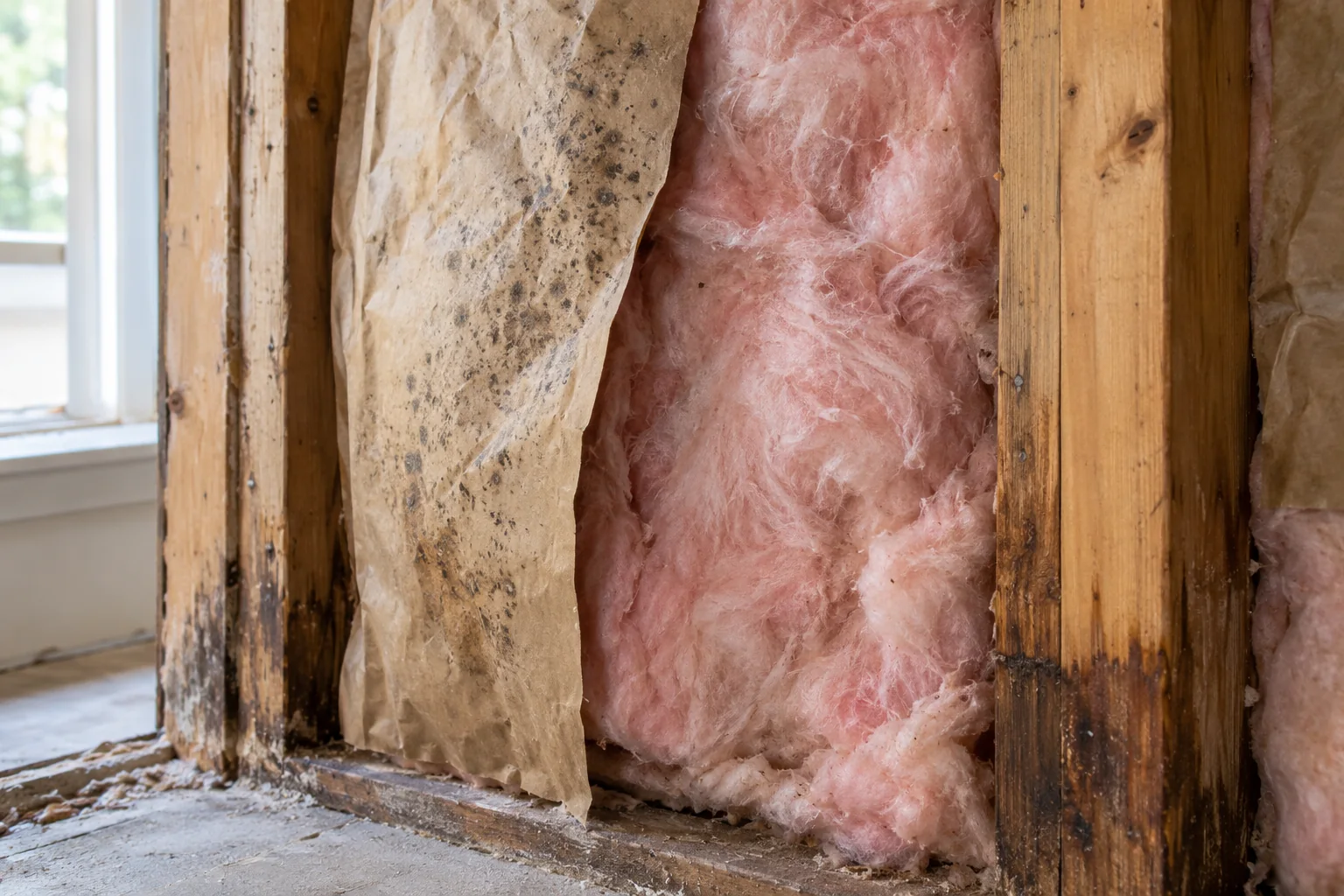
Kraft paper facing is a separate layer from the fiberglass core. NAIMA's insulation FAQ describes facing as a vapor-retarder layer. Paper, surface dust and nearby wood require attention during a moisture investigation.
- Fiberglass core condition answers whether the insulating material was wetted or contaminated.
- Paper-facing condition identifies a different surface from the glass fibers.
- Framing and sheathing condition identifies building materials that remain after insulation removal.
- Dust deposits identify surface contamination without proving a mold species.
Cellulose insulation has a different composition from fiberglass. The Department of Energy insulation guide describes cellulose as treated recycled paper. A treatment claim does not establish that water-damaged cellulose is suitable for reuse.
Is black or gray insulation always mold?
Black or gray insulation is not a reliable mold diagnosis by itself. Surface discoloration identifies a place to investigate. An inspection still needs the exposure history and the condition of the surrounding materials.
Air leakage also moves dust through building assemblies. DOE's insulation guide connects air leakage with both dust transport and moisture problems. A dark band near an opening therefore needs investigation rather than a species label from a photograph.
Visible mold and moisture do not require a species identification before correction. CDC's household guidance does not recommend routine home mold testing. A household bleach spot test does not establish the condition of concealed facing or framing.
Can a moisture meter or thermal camera detect mold in insulation?
A moisture meter measures moisture-related conditions. A thermal camera shows temperature patterns. Neither measurement identifies mold. FLIR's thermal-imaging guidance explains that a temperature pattern does not guarantee the presence of water. Suspected moisture needs confirmation with an appropriate measurement.
| Evidence | Useful for | Does not establish |
|---|---|---|
| Photograph or visual inspection | Locating discoloration, deterioration and exposed layers | A species identification or the condition behind a closed cavity |
| Room relative humidity | Recording moisture in room air at the measurement time | Whether insulation inside a wall is dry |
| Thermal image | Locating temperature differences for further investigation | Water presence without confirmation |
| Material moisture reading | Assessing a named material with a suitable instrument | A mold diagnosis or a universal pass value for every insulation product |
An insulation inspection record should name the measured material and the instrument used. A wood reading should not be presented as an insulation moisture percentage. A dry room reading should not substitute for checking a previously wet cavity.
What needs fixing before new insulation is installed?
The moisture source and affected surrounding materials need attention before replacement insulation closes the cavity. EPA's household cleanup guide makes moisture correction central to preventing recurrence. New insulation does not repair a roof leak or remove growth on retained wood.
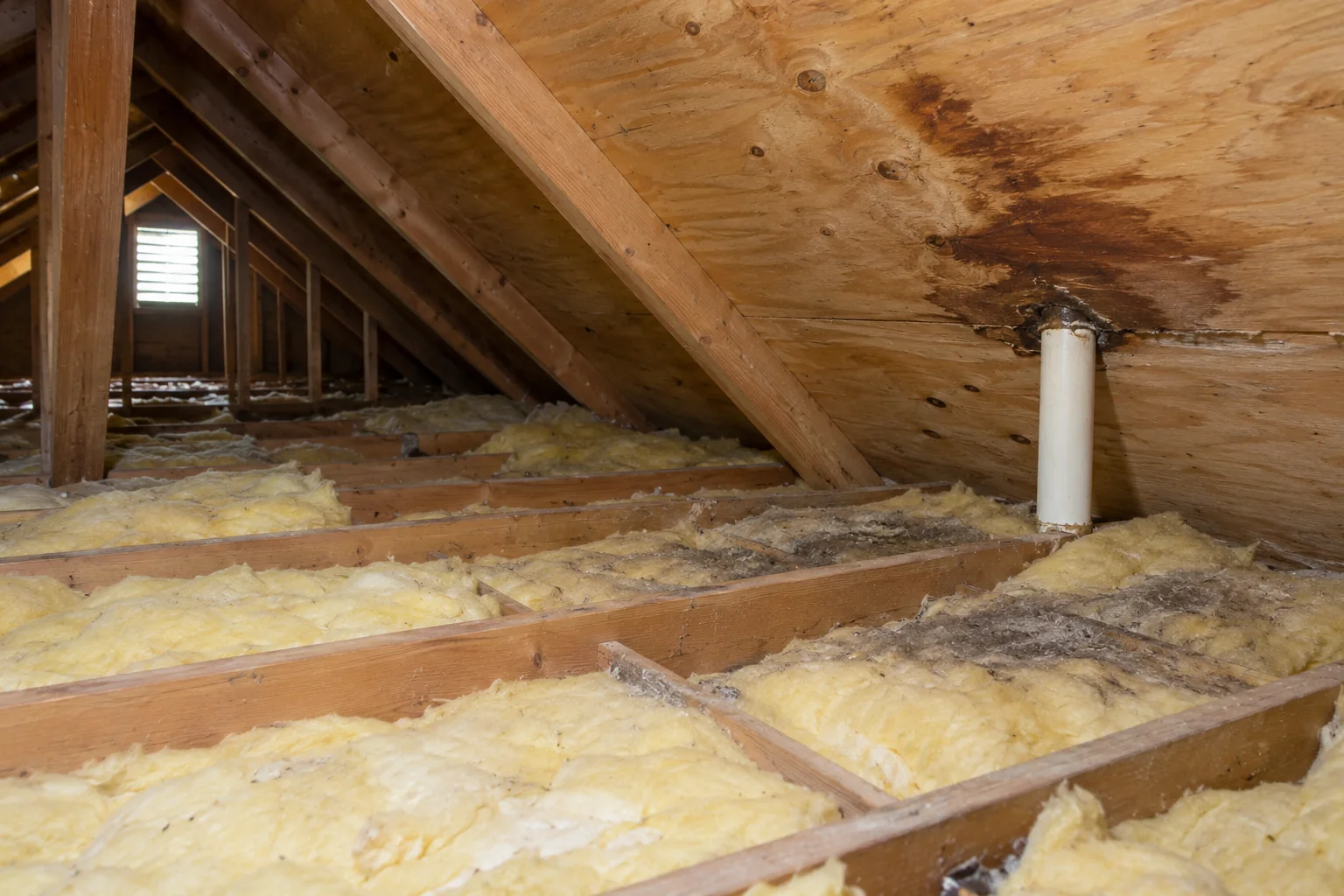
Attic moisture needs an assessment of the roof assembly, air movement and exhaust routes. A vented attic and a sealed attic require different building-design decisions. Adding a fan or switching insulation types is not a universal correction.
- Locate the leak, condensation source or moisture-carrying air path.
- Assess affected insulation and exposed framing separately.
- Remove unsalvageable materials and address retained surfaces.
- Confirm the cavity's condition before installing replacement insulation.
- Restore the insulation and moisture-control details appropriate to the assembly.
Roof-deck contamination belongs within an attic insulation and roof-deck mold assessment when the problem extends beyond loose fill or batts. Adjacent wall damage also needs a drywall facing and cavity assessment before the wall is closed.
When should insulation removal be left to a professional?
Suspected asbestos, contaminated water and extensive or hidden mold warrant qualified professional assessment. EPA's household guide uses about 10 square feet as a cleanup-scope threshold. The threshold does not determine whether insulation is salvageable.
Vermiculite insulation should remain undisturbed because it may contain asbestos. EPA's vermiculite advice directs removal work to trained and accredited asbestos-abatement contractors. Pulling material apart for a closer photograph is inappropriate when vermiculite is suspected.
Indoor humidity control supports prevention after the source is corrected. CDC recommends humidity no higher than 50%. Room humidity control does not dry a concealed leak by itself.
Gettysburg Mold Remediation Help provides a free referral service for mold removal and moisture assessment in Gettysburg homes through independent companies. The independent company assesses the property, prices the proposed work and performs the service.