
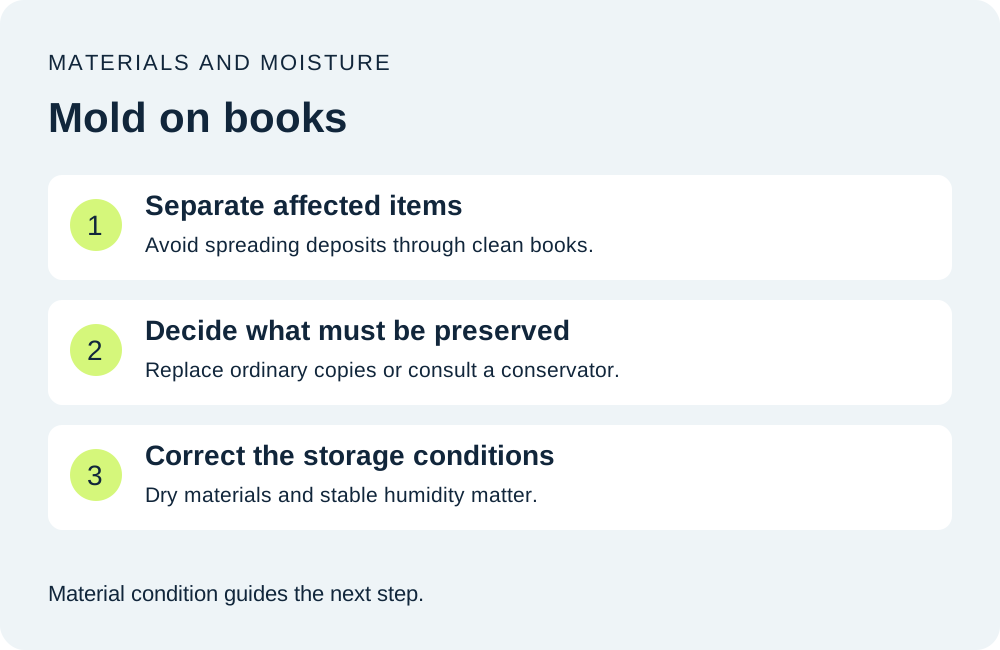
What should you do with moldy books first?
Moldy books need separation from unaffected books and a prompt decision between replacement and conservation. A replaceable paperback and a handwritten family journal deserve different recovery plans. Active, damp growth should remain undisturbed while the moisture problem is addressed.
Book recovery begins with the room as well as the object. A leaking pipe above a shelf, damp carton on a basement floor or condensation behind a bookcase supplies moisture. Moving a book into another damp storage space leaves the cause unresolved.
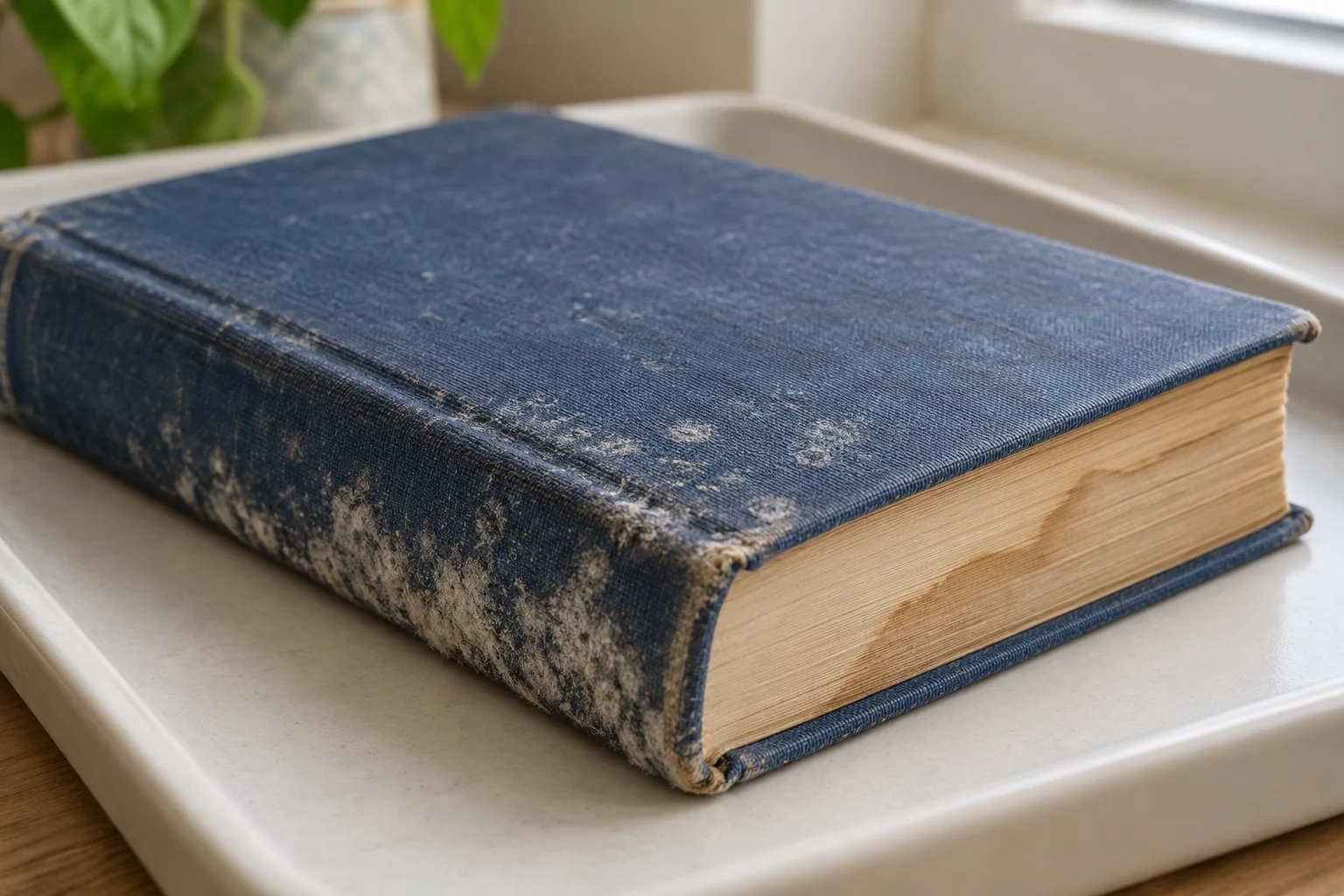
Book handlers should limit exposure to suspected mold. The Library of Congress wet-collections guidance recommends protective equipment and cautions against disturbing active growth. People with mold allergies, asthma or weakened immune systems should avoid cleanup and seek appropriate help.
- Access: Keep children, pets and unnecessary handling away from affected books.
- Separation: Keep suspect items apart from clean collections without brushing, shaking or fanning mold into the room.
- Moisture: Arrange to stop leaks and reduce dampness around the collection.
- Value: Identify unique documents before discarding replaceable books.
Can books and paper with mold be saved?
Some mold-affected books and paper can be stabilized and cleaned by a conservator, but damaged fibers, stains and bindings may remain. Recovery is not a promise to restore the original appearance. Replacement is often the practical option for ordinary books with readily available copies.
Collection recovery costs can exceed the value of a replacement copy, according to the Library of Congress. A signed inscription, unique handwriting or historic binding changes the value decision. A digital or replacement copy preserves readable information without preserving the original physical object.
| Item | Decision priority | Appropriate route |
|---|---|---|
| Ordinary replaceable book | Accessible replacement and extent of damage | Consider replacement instead of repeated home treatments. |
| Family records or unique annotations | Information and original material both matter | Contact a paper or book conservator before cleaning. |
| Wet coated pages stuck together | Page separation risks tearing or loss | Keep pages together pending urgent conservation advice. |
| Fragile leather, vellum or parchment | Binding reacts differently from ordinary paper | Request a material-specific stabilization plan. |
| Library or borrowed book | Owner controls treatment and replacement | Tell the library about the damage before returning the item. |
Household contents recovery and book conservation are different specialties. Gettysburg Mold Remediation Help offers a free referral service for assessment of mold-affected belongings by independent companies. Rare-book conservation should be confirmed separately rather than assumed to be part of a general cleanup service.
Are brown spots or a musty book smell always mold?
Brown spots and a musty smell do not independently identify active mold on a book. Foxing, dirt, water stains and deposits on bindings can resemble growth. A photograph cannot establish a mold species or the condition of every page.
Book conservators distinguish active growth from dry deposits and permanent staining. NEDCC illustrates these differences in its moldy-books preservation leaflet. Dry, inactive mold still needs careful handling and can resume growth under favorable moisture conditions.
| Observation | What the observation suggests | What the observation does not establish |
|---|---|---|
| Fuzzy deposits on damp cloth | Possible active growth requiring isolation | A species, health diagnosis or safe cleaning method |
| Dry powder on a binding | Possible inactive mold or another deposit | That the material is harmless or ready to reshelve |
| Flat rust-colored spots | Possible foxing or staining | That rubbing or bleaching the page is appropriate |
| Lingering musty odor | A reason to inspect the item and storage area | Whether concealed growth remains or the book can be saved |
How quickly do wet books need drying?
Wet books need immediate attention, with conservation advice if drying cannot be completed within 48 hours. The University of Illinois preservation guidance describes freezing as a possible stabilization step for books that cannot be dried in that window. The 48-hour window is an emergency planning target, not a guarantee that mold starts at a fixed hour.
Wet paper tears more easily during handling. Forcefully opening a swollen volume or pulling apart stuck pages risks losing text and surface coatings. A conservator can choose a drying method for the paper, ink and binding together.
Book drying must also control airborne contamination. Illinois advises against directing fans straight at drying books. Widespread growth, contaminated floodwater or an unsuitable work area calls for professional assistance rather than a fan directed across a household collection.
Does freezing a moldy book kill the mold?
Freezing a moldy book is a stabilization method, not proof that the book has been cleaned or made ready to read. Cornell's collection mold guidance separates stabilization, drying and removal. Damp materials still require a controlled recovery plan after freezing.
Book materials limit freezer treatment. NEDCC excludes leather-bound books, vellum, parchment, photographs and audiovisual materials from its general freezing advice. A mixed box of family records should therefore be assessed before applying one treatment to everything.
Plastic bags require a defined purpose. NEDCC warns against sealing a moldy book in a bag if freezing will not follow. A bag that traps moisture during ordinary storage creates a different problem from temporary containment during a planned salvage procedure.
Can bleach, vinegar or sunlight remove mold from books?
Household chemical treatments and sunlight are not dependable book-conservation methods. Cornell warns that cleaners applied to books can cause serious damage. Sun exposure can also fade or discolor paper and bindings.
Paper cleaning differs from scrubbing a washable hard surface. Fragile fibers, soluble inks and decorated covers make a general spray recipe inappropriate. An oven or microwave is not an alternative to a material-specific recovery plan.
Professional book cleaning uses controlled handling and appropriate equipment. The Library of Congress describes a conservation workflow with a fume hood and adjustable HEPA vacuum for dry affected materials. Screens protect fragile items during treatment. A normal vacuum at a kitchen table does not recreate that controlled setup.
How do you prevent mold from returning to books?
Book mold prevention requires dry materials, a corrected moisture source and stable storage humidity. The Library of Congress recommends stable relative humidity no higher than 55% for most books. The book-preservation guide also warns about rapid humidity changes and excessive drying.
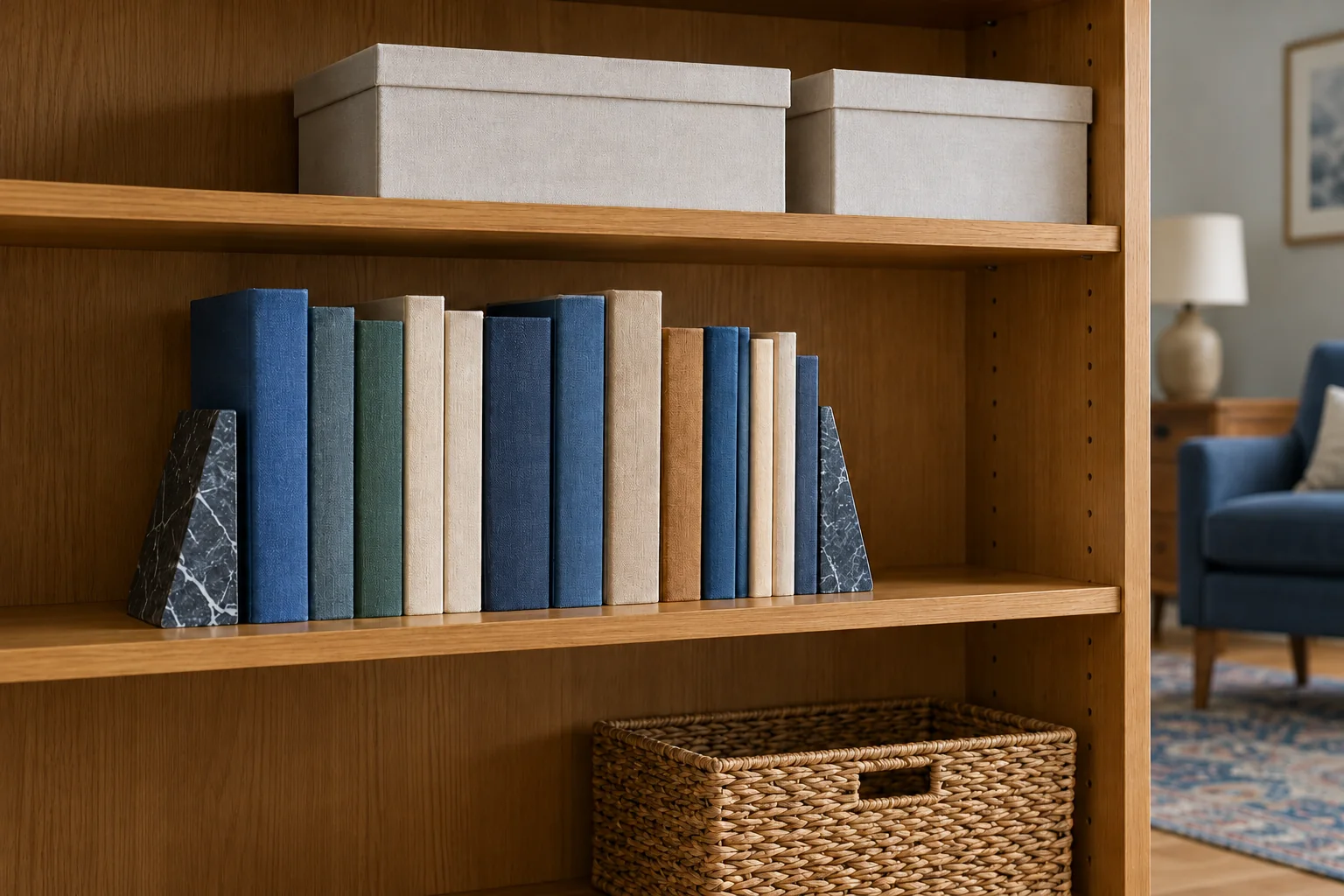
- Location: Keep books away from leak-prone plumbing, damp basement floors and condensation-prone walls.
- Support: Use supportive shelves and bookends without forcing volumes into a tightly packed row.
- Housing: Choose acid-free, lignin-free storage materials for valued paper collections.
- Monitoring: Measure room humidity and inspect previous problem areas after damp weather or a leak.
Book-storage boxes do not correct a damp room. A cleaned collection should return only after both the items and the storage area have been assessed. Gettysburg Mold Remediation Help connects homeowners seeking mold assessment in Gettysburg homes with independent companies that evaluate the building and provide their own scope and pricing.